
Culinary Medicine in Nursing: A Step-by-Step Integration Guide
Last Updated: November 3, 2026
Quick Summary
To integrate culinary medicine nursing into practice, build a bedside-to-community workflow that screens patients for food access and kitchen capability, teaches one repeatable food skill with teach-back before discharge, adapts teaching to the patient's real food environment, refers with clear triggers, and follows up on a fixed cadence. Measure nursing competency, patient outcomes, and equity data before expanding.
- Screen at admission with a two-question trigger covering food access and kitchen capability.
- Teach one repeatable skill before discharge and confirm it with teach-back.
- Refer to a dietitian for complex medical nutrition therapy and therapeutic diet prescription.
- Follow up 48 to 72 hours after discharge, at two weeks, and at one month.
- Set a review date of 90 days for process measures and six months for patient outcomes.
Table of Contents
- What Culinary Medicine Brings to Nursing Practice
- Patient Nutrition Assessment Tools for Nurses
- Nursing Scope of Practice and Nutrition Counseling
- Step 1: Build the Clinical Case and Plan Your Curriculum
-
Step 2: Map a Bedside-to-Community Workflow
- Stage 1: Screen at Admission With a Two-Question Trigger
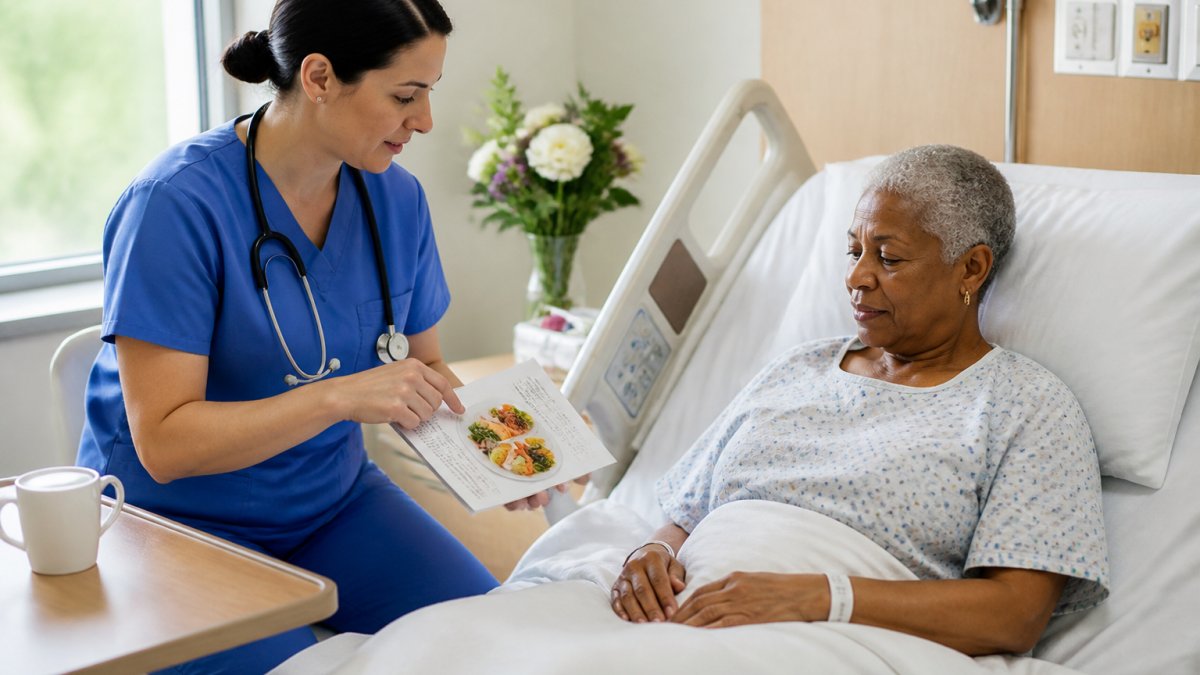
- Stage 2: Teach One Repeatable Skill Before Discharge
- Stage 3: Adapt to the Patient's Real Food Environment
- Stage 4: Refer With a Clear Trigger, Not a Vague Suggestion
- Stage 5: Follow Up on a Fixed Cadence
- Low-Cost Delivery Without a Teaching Kitchen
- Integrating Kitchen Herbalism Into Nursing Care
- Culinary Medicine Certification for Nurses
- Step 3: Measure Competency, Outcomes, and Equity
- Frequently Asked Questions
What Culinary Medicine Brings to Nursing Practice
Culinary medicine is the evidence-based practice of combining cooking skills with medical knowledge so health professionals can use food as a therapeutic tool. Empowering patients to navigate these daily choices requires a practical framework for dietary blood glucose management that translates clinical goals into sustainable habits.
The gap is real. A patient leaves with a handout and no idea how to cook from it. Culinary medicine nursing closes that gap by turning advice into skills.
Why Food Skills Belong in Clinical Care
Diet-related disease drives much of the chronic illness nurses manage daily. Yet most clinical training stops at "eat more vegetables." A 2024 study describes culinary medicine as an evidence-based approach that pairs cooking skills with medical knowledge to help health professionals use nutrition therapeutically (Fernando et al., culinary medicine study). That is a clinical skill, not a lifestyle tip.
Three reasons it belongs in nursing:
Patient Nutrition Assessment Tools for Nurses
Start every culinary medicine conversation with a quick, structured assessment. You do not need a full dietitian workup to spot who needs food-skills support.
Practical tools you can use at the bedside:
- Food access screen: Ask about transportation, budget, and whether the patient can cook at home.
- 24-hour recall: A short conversation about what they ate yesterday reveals patterns fast.
- Food allergy and intolerance check: Flag any restrictions before teaching recipes.
The 2025 research notes that culinary medicine spans multiple professions and settings, and older definitions may miss its current scope (defining the evolving field of culinary medicine). For nurses, that means assessment should cover practical food access, not just nutrition knowledge.
Nursing Scope of Practice and Nutrition Counseling
Nurses can counsel on nutrition within their scope, but scope varies by state and license level. Check your state board of nursing for the rules that apply to you.
A simple boundary rule keeps you safe:
| Task | Nurse | Refer Out |
|---|---|---|
| General healthy eating guidance | Yes | No |
| Cooking skills and meal planning | Yes | No |
| Food allergy education | Yes | No |
| Complex medical nutrition therapy | No | Dietitian |
| Therapeutic diet prescription | No | Dietitian or physician |
When in doubt, refer. That boundary protects patients and your license.
Step 1: Build the Clinical Case and Plan Your Curriculum
Before you teach a single cooking class, build the case. Leaders approve programs that show a clear problem, a defined audience, and a plan for where the content fits.
Build your case with four inputs:
- Patient population: Which diet-related conditions fill your caseload?
- Current gaps: What does your team already teach, and where does it fall short?
- Resources: Do you have a kitchen, a community partner, or only a break room?
- Outcomes: What will you measure in six months?
A 2026 feasibility project examined adding culinary medicine to a Doctor of Nursing Practice curriculum without increasing credit hours or program length (EXTERNAL_LINK: 2026 Culinary Medicine Conference posters | culinarymedicine.org). If your curriculum includes food-skills content, a beginner roadmap for clinical herbalism can help ground it.
Curriculum Planning and Curricular Timing
Timing decides whether a program survives. A 2024 article on curricular integration stresses planning around where and when to integrate culinary medicine, plus coordination with institutional education (Thomas et al., curricular integration strategies).
Step 2: Map a Bedside-to-Community Workflow
Nurses need a workflow they can run on a Tuesday shift, with limited time, no teaching kitchen, and a patient going home to a food environment you cannot see.
Stage 1: Screen at Admission With a Two-Question Trigger
You do not need a full dietitian workup to decide who gets food-skills support. Use a short screen that fits inside the admission assessment you already document:
- Food access question: "In the last month, did you worry about running out of food before you had money to buy more?" A yes flags food insecurity and changes what you teach, a recipe that assumes a full pantry is useless to this patient.
- Kitchen capability question: "Can you cook at home right now, do you have a working stove, a fridge, and the pots you need?" A no flags limited kitchen access, disability, or housing instability and routes the patient toward no-cook and ready-to-eat options instead of cooking classes.
Pair the screen with a 24-hour recall, an allergy and intolerance check, and a cultural food review. Document answers in a structured field, not free text, so you can pull the data later for the outcomes layer in Step 3.
Watch out: a food-insecurity screen is not a diagnosis and should never shame a patient, frame it as "so I can connect you with the right resources," and have the referral list ready before you ask.
Stage 2: Teach One Repeatable Skill Before Discharge
One skill, taught once, demonstrated and then performed back by the patient, beats a handout with twenty tips. Choose the skill from the patient's actual condition and food access:
- Diabetes or prediabetes: teach the plate method using foods the patient already eats, and one low-cost meal they can repeat for breakfast.
- Heart failure or hypertension: teach a no-salt seasoning swap, a spice blend instead of a bouillon cube, and one canned-good rinsing step.
- Chronic kidney disease: do not improvise; teach only what the renal dietitian has approved and refer for the rest.
Use teach-back: "Show me how you'd make this at home." If the patient cannot walk you through it, the skill did not land, and the referral in Stage 4 becomes more important than the teaching.
Stage 3: Adapt to the Patient's Real Food Environment
This is where most programs lose patients. Adapt the teaching to what the patient can actually do:
- Food insecurity: prioritize shelf-stable, low-cost proteins and produce that is affordable in the patient's area; connect to a food pantry or produce-prescription program before discharge.
- No kitchen or limited cooking access: teach no-cook assembly, yogurt and fruit, canned beans and pre-cut vegetables, rotisserie chicken and bagged salad, rather than recipes that require an oven.
- Cultural adaptation: build the teaching around foods the patient already cooks. A 2024 article presents cultural food knowledge as a path to more personalized care and stronger patient-provider relationships (culturally responsive culinary practices). Ask the patient to name a dish they make often, then adjust that dish rather than replacing it.
Stage 4: Refer With a Clear Trigger, Not a Vague Suggestion
Referral boundaries are the safety rail of the whole workflow. Use these triggers:
SlimRoots Kitchen Herbalism Weight Tea Blend →
- Refer to a registered dietitian for complex medical nutrition therapy, therapeutic diet prescription, tube feeding, renal or oncology nutrition, or any patient whose needs exceed general healthy-eating guidance.
- Refer to a pharmacist or physician when an herb or supplement could interact with a medication, blood thinners, diabetes drugs, and blood pressure medication are the highest-caution categories.
- Refer to a social worker or community health worker when the screen flags food insecurity, housing instability, or transportation barriers.
When in doubt, refer. That boundary protects patients and your license.
Stage 5: Follow Up on a Fixed Cadence
A workflow without follow-up is a discharge handout with extra steps. Set the follow-up at the same time you set the referral:
- 48 to 72 hours after discharge: a phone check that the patient has the food or resource you connected them to.
- Two weeks: a call or visit that asks whether the taught skill was used and what got in the way.
- One month: reassess the screen and document whether the patient's food access or confidence changed.
Record what was taught, where the patient was referred, and whether follow-up happened. That record turns patient counseling into a measurable handoff, and it is the raw material for the competency and outcome measures in Step 3.
Low-Cost Delivery Without a Teaching Kitchen
Most nursing units will never have a teaching kitchen, and that is not a reason to skip the workflow. Options that fit limited space and funding:
- Brief bedside demonstrations: a bowl, a can of beans, and a plastic knife can teach a no-cook meal in five minutes.
- Virtual sessions: a short video call with a community partner or dietitian who can walk the patient through one meal.
- Printed and pictorial handouts: one recipe per page, with pictures, in the patient's preferred language.
Start with one unit, one condition, and one skill, then expand once the follow-up data shows the workflow is sticking.
Integrating Kitchen Herbalism Into Nursing Care
Kitchen herbalism fits naturally into culinary medicine nursing, with one non-negotiable rule: safety first. Herbs can interact with medications, so screen every patient before recommending anything.
Use these guardrails:
- Ask about all medications and supplements at every visit.
- Flag blood thinners, diabetes drugs, and blood pressure medication for extra caution.
- Teach food-first herbs, like culinary spices, before concentrated preparations.
A 2024 article presents cultural food knowledge as a path to more personalized care and stronger patient-provider relationships (culturally responsive culinary practices). Before you recommend any herb, read our safety primer on herbal medicine. Patients interested in kitchen herbs can ask their healthcare provider about options such as the SlimRoots Kitchen Herbalism Weight Tea Blend, which is an RN-formulated herbal tea.

Culinary Medicine Certification for Nurses
Culinary medicine certification for nurses is training that builds cooking and food-counseling skills on top of a nursing license. It is not a replacement for a dietitian credential, and it does not expand your scope. It sharpens how you teach.
What to check before you enroll:
- Does the program cover hands-on cooking, not just lectures?
- Does it address scope of practice and referral boundaries?
- Does it include behavior change and patient counseling?
If a program includes herbal training, verify those credentials too.
Step 3: Measure Competency, Outcomes, and Equity
Programs that measure nothing get cut. Build your evaluation around three layers, what nurses can do, what patients achieve, and who is being reached, and define each measure before the first class.
Layer 1: Nursing Competency, With a Rating Scale
A competency framework only works if each item can be observed and rated. Use a simple four-point scale (not yet, developing, proficient, exemplary) and assess each nurse at baseline and again after the training:
- Knowledge: Can the nurse explain a dietary recommendation in plain language, without jargon, in under two minutes?
- Skill: Can the nurse demonstrate a basic meal preparation, for example, assembling a plate-method meal from foods the patient already has?
- Counseling: Can the nurse hold a brief behavior-change conversation using teach-back and open-ended questions?
Score the vignettes against an answer key so competency is comparable across nurses and across cohorts. A common pattern is that knowledge scores rise quickly while referral and documentation scores lag, those are the two to coach.
Layer 2: Patient Outcomes, One Concrete Measure per Condition
Pick one primary measure per condition rather than a dashboard no one reads:
- Diabetes or prediabetes: patient confidence in preparing a diabetes-appropriate meal, measured on a short pre/post confidence scale, plus a repeat of the taught skill at the two-week follow-up.
- Heart failure or hypertension: whether the patient can name and demonstrate one salt-reduction swap at follow-up.
- General prevention: whether the patient used the community resource they were referred to within one month.
Track process measures alongside outcomes: nutrition-screen completion rate, referral rate by referral type, and follow-up completion rate. These move first and tell you whether the workflow is running before you attribute patient change to it. For diabetes, an anti-inflammatory framework can give you something teachable and trackable.
Layer 3: Equity, Stratified Not Aggregated
An aggregate outcome number can look good while hiding the patients you are not reaching. Stratify every measure by the variables your screen already captures:
- Food insecurity status at admission.
- Kitchen access (full kitchen, limited, none).
- Primary language and cultural food preference.
If follow-up completion is lower for food-insecure patients, the workflow is failing the people it was built for, fix the follow-up channel (text instead of phone, community health worker instead of clinic call) before expanding the program. A 2026 review of pediatric culinary medicine identified implementation challenges and strategies for building programs in clinical settings (2026 pediatric culinary medicine review).
Set a Baseline and a Review Date
Before launch, record the baseline for each measure and set a review date, commonly 90 days for process measures and six months for patient outcomes. Report to leadership in the format they already use for quality metrics, and tie the report back to the case you built in Step 1. That is what keeps a culinary medicine program from being cut when the budget cycle turns.
Frequently Asked Questions
What is the role of a nurse in culinary medicine?
Nurses translate nutrition science into daily food choices patients can actually follow. That means screening for food access and cooking ability, counseling on practical food preparation, and connecting patients to teaching kitchens or community resources. A 2026 article in the Journal for Nurse Practitioners describes a Nutrition as Medicine framework for bringing these interventions into clinical practice. Nurses do not replace dietitians; they handle everyday food education and refer complex cases onward.
Are there specific culinary medicine certification for nurses programs?
Formal certification options exist, and the field is still evolving. A 2025 review notes that culinary medicine spans multiple professions and settings, and earlier definitions may not capture its current scope. Before enrolling, check whether a program includes hands-on cooking hours, interprofessional education, and a competency assessment. Pair any certification with your state board's continuing education rules and your employer's credentialing process so the training counts toward your practice.
How does culinary medicine differ from traditional medical nutrition therapy?
Medical nutrition therapy is individualized clinical treatment delivered by a registered dietitian. Culinary medicine is the experiential, skills-based side: cooking skills, food preparation, and behavior change support that help patients apply dietary recommendations. A 2024 study describes it as an evidence-based approach combining cooking skills with medical knowledge so health professionals can use nutrition therapeutically. The two work best together, with nurses reinforcing practical skills between dietitian visits.
What are the first steps for adding food-based interventions to patient care plans?
Start with a short nutrition assessment: food access, cooking confidence, cultural food traditions, and dietary restrictions. Then pick one achievable food behavior per visit instead of a full overhaul. Coordinate with your institution on curricular timing and documentation, since a 2024 article identifies integration space and timing as real implementation constraints. Track one or two measurable outcomes, such as patient engagement with a meal plan, before expanding the program.
Integrating culinary medicine into nursing practice starts with one assessment, one skill, and one follow-up. That is how you build a program that lasts. At HighFiveHive Nature's Remedies-Kitchen Herbalism, our RN-led kitchen herbalism brings 40 years of nursing experience to natural diabetes support, women's wellness, and immune health. Get started with HighFiveHive Nature's Remedies-Kitchen Herbalism and give your patients food skills they can actually use.


Leave a comment