
Herbal Tea vs Supplements for Women's Wellness
Table of Contents
- Herbal Tea vs Supplements: A Quick Comparison Table
- Bioavailability and Absorption: Tea Infusion vs Pill
- Herbal Support for Hormonal Health: What the Evidence Says
- FDA Dietary Supplement Health and Education Act: What It Means for Your Choices
- Safety, Drug Interactions, and Side Effects to Know
- Kitchen Herbalism for Beginners: Making Your Own Tea Blends
- Dosage Standardization and Quality: Tea vs Supplements
- Conclusion: Choosing Your Path to Wellness
- Frequently Asked Questions
Last Updated: September 16, 2026
Herbal Tea vs Supplements: A Quick Comparison Table
The choice between herbal tea vs supplements for women's wellness comes down to how much of the active plant compounds your body actually absorbs, and how consistent you are with taking them. Tea offers gentler, slower absorption with a built-in daily ritual. Concentrated supplements and tinctures deliver a higher dose in seconds but demand more caution around interactions. Neither is universally better.
The short answer: tea suits daily hormonal and stress support, while tinctures suit targeted, measured dosing.
| Factor | Herbal Tea | Concentrated Supplements/Tinctures |
|---|---|---|
| Absorption | Slower, gentler via hot water extraction | Faster, higher peak dose |
| Dosing precision | Loose, hard to standardize | Measurable per dropperful |
| Routine | Built-in ritual, easy to sustain | Requires discipline and timing |
| Interaction risk | Lower, but real | Higher, especially with medication |
| Best for | Daily hormonal and stress support | Targeted therapeutic dosing |
Bioavailability and Absorption: Tea Infusion vs Pill
Bioavailability is the proportion of an active compound your body actually absorbs and can use, and it differs sharply between an infusion and a capsule. Steeping herbs in hot water extracts water-soluble compounds like the flavonoids in lemon balm and peppermint. Alcohol-based tinctures pull a broader range of plant constituents, including some that water alone misses.
Heat and steeping time matter, and so does the form of the herb. Many herbalists favor tinctures when a specific, repeatable amount of a botanical is the goal, and tea when the goal is gentle, daily support. For a deeper look at how the body processes these compounds, the NIH Office of Dietary Supplements publishes plain-language guidance on dietary supplements and absorption.
Herbal Support for Hormonal Health: What the Evidence Says
Herbal support for hormonal health refers to using specific botanicals to gently influence the body's natural balance during life stages like perimenopause and premenstrual syndrome. Certain herbs have long histories in women's preparations: black cohosh, chaste tree berry, red clover, and dong quai among them. The evidence base varies by herb, and most traditional use predates modern trials.
What matters is honesty about what these botanicals can and cannot do. They support comfort and daily balance. They are not a replacement for medical treatment of a diagnosed hormonal condition. If your symptoms are severe or persistent, a clinician should be part of the conversation. Our Five Botanicals: A Woman's Traditional Tincture blends black cohosh, dong quai, ashwagandha, red clover, and chaste tree berries in a traditional liquid extract for those who prefer a measured daily dose.

FDA Dietary Supplement Health and Education Act: What It Means for Your Choices
The FDA Dietary Supplement Health and Education Act shapes how supplements reach your shelf, and understanding it changes how you shop. Under this framework, dietary supplements are regulated as a category of food rather than as drugs. That means they do not require premarket approval for safety and effectiveness the way pharmaceuticals do.
Practically, this places more responsibility on you and on the maker. Look for transparent ingredient lists, clear suggested use, and honest disclaimers. Any product claiming to diagnose, treat, cure, or prevent disease is overstepping what the law allows. The FDA's dietary supplements guidance explains the premarket and labeling rules in detail. When a label is vague about potency or sourcing, treat that as a reason to keep looking.
Safety, Drug Interactions, and Side Effects to Know
Safety is where herbal tea and concentrated supplements diverge most. Herbs contain pharmacologically active compounds. That is the whole point of using them, and it is also why they can interact with prescription medication, affect lab results, and cause side effects that range from annoying to serious.
Here is a concrete look at the herbs most common in women's wellness blends, and what to watch for.
St. John's wort. The best-documented herbal interactor. It induces liver enzymes in the CYP450 family, which speeds the breakdown of many drugs and can lower their blood levels. It has been shown to reduce the effectiveness of oral contraceptives, some antidepressants, warfarin, and certain HIV and transplant medications. Combining it with SSRIs or other serotonergic drugs raises the risk of serotonin syndrome, a rare but serious condition marked by agitation, rapid heart rate, sweating, and muscle rigidity.
Black cohosh. Used for menopausal symptoms. Rare cases of liver injury have been reported, so anyone with existing liver disease or a history of hepatitis should be cautious. Symptoms to watch for include yellowing of the eyes or skin, dark urine, and unexplained fatigue.
Chaste tree berry (vitex). Popular for cycle support. It can affect prolactin and may interfere with hormonal contraceptives and fertility medications. It is generally avoided during pregnancy.
Dong quai. A traditional blood-building herb. It contains compounds that can thin the blood, so combining it with warfarin, aspirin, or other anticoagulants is a real concern.
Red clover. Contains isoflavones that can act weakly estrogenic. Women with hormone-sensitive conditions, or those on tamoxifen or hormone therapy, should talk to their provider before using it.
Peri Harmony Woman's Collection →
Valerian, passionflower, and other sedating herbs. These can amplify the effects of sleep medications, anti-anxiety drugs, and alcohol. If you drive or operate machinery, dose timing matters.
Peppermint and other soothing teas. Generally low risk, but large amounts of peppermint oil can worsen acid reflux in some people and may interact with certain antacids.
A few cautions worth keeping in mind:
- Not for use during pregnancy or while breastfeeding without professional guidance.
- Check with your healthcare provider before combining herbs with any prescription.
- Stop use if you notice an adverse reaction, and tell your provider what you were taking.
- Be cautious with sedating herbs like valerian if you drive or operate machinery.
- Tell your provider about herbal use before surgery, some herbs affect bleeding and blood pressure.
Serotonin syndrome is a rare but serious concern when certain herbal and pharmaceutical agents combine. This is exactly why an RN-led approach matters: someone trained to ask about your medications before recommending a botanical.
One practical habit: keep a single list of every herb, tea, tincture, and supplement you take, with the amount and how often. Bring it to every appointment.
Kitchen Herbalism for Beginners: Making Your Own Tea Blends
Kitchen herbalism for beginners is the practice of blending and preparing simple herbal teas at home using dried botanicals, hot water, and a little patience. You do not need special equipment to start. A kettle, a strainer, and a few quality dried herbs cover most of it. Developing a consistent routine with these infusions allows you to explore how specific herbal teas for energy can support your vitality throughout the day.
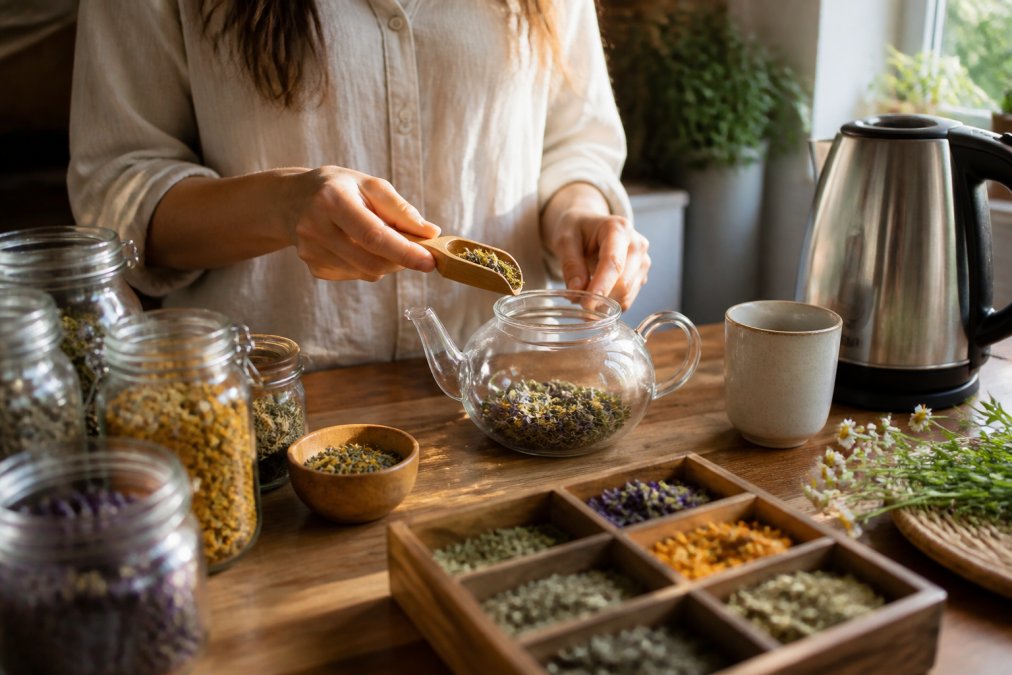
Start with a simple framework:
- Pick a base herb for flavor, such as peppermint or lemon balm.
- Add one supporting botanical, like red clover blossom.
- Use one teaspoon of the blend per cup.
- Pour water just off the boil, around 200°F, over the herbs.
- Cover and steep 5 to 7 minutes, then strain.
Dosage Standardization and Quality: Tea vs Supplements
Dosage standardization is the biggest practical difference between tea and concentrated supplements, and it is where most buying mistakes happen. A standardized extract is formulated to deliver a consistent amount of a marker compound batch to batch. Loose tea cannot promise that. A teaspoon of one harvest may be stronger than the next.
Conclusion: Choosing Your Path to Wellness
The honest answer is that herbal tea vs supplements for women's wellness is not a contest with one winner. Tea wins on ritual, gentleness, and daily consistency. Tinctures and concentrated supplements win on precision and targeted dosing. Many women use both: a calming tea in the evening and a measured tincture in the morning.
Frequently Asked Questions
Are herbal teas as effective as supplements for hormone balance?
It depends on the herb and the dose. Teas provide lower concentrations of active compounds, while standardized supplements offer consistent, higher doses. For mild support, teas can be part of a daily ritual. For targeted hormonal balance, a tincture or capsule may be more reliable. Always talk to your healthcare provider before using either, especially if you take medication.
What are the FDA regulations regarding herbal supplements versus food-grade teas?
Under the FDA Dietary Supplement Health and Education Act, supplements are regulated as food but must meet labeling and good manufacturing practice rules. Teas are regulated as conventional food, not as supplements. Neither category is approved by the FDA for treating any condition. The FDA can act against unsafe products, but it does not review them for effectiveness before sale.
How do I choose between loose-leaf herbal tea and encapsulated supplements?
Think about your routine and goals. If you enjoy a daily ritual and want gentle support, loose-leaf tea is a good fit. If you need a consistent, measured dose of specific herbs, a tincture or capsule may work better. Consider cost, taste, and convenience. Many women use both: tea for relaxation and a tincture for targeted support.
Can herbal teas and supplements be used together safely?
Sometimes, but not always. Some herbs can interact with each other or with prescription drugs. Always check with your doctor or pharmacist before combining herbal products. Keep a list of everything you take, including teas, tinctures, and pills, and share it at appointments.
What are the bioavailability differences between tea infusions and supplement pills?
Tea infusions extract water-soluble compounds, so you absorb a modest amount. Supplements, especially liquid tinctures or standardized extracts, often deliver higher concentrations of active compounds. Bioavailability also depends on the herb's form and your body. For example, a tincture may absorb faster than a dry capsule. If you need a therapeutic dose, a supplement is usually more predictable.


Leave a comment