
Best Herbal Remedies for Inflammation: 7 Natural Options
Table of Contents
- Natural Anti-Inflammatory Herbs That Actually Have Evidence
- Herbal Support for Joint Health: What Works and What Doesn't
- The Safety of Herbal Supplements for Inflammation: What You Need to Know
- How to Get the Most from Herbal Remedies: Bioavailability and Dosage
- Herbal Teas and Infusions for Inflammation
- Condition-Specific Protocols: Using Herbal Remedies for Inflammation
- Frequently Asked Questions
Last Updated: September 15, 2026
Natural Anti-Inflammatory Herbs That Actually Have Evidence
The best herbal remedies for inflammation are turmeric, ginger, and boswellia, three botanicals with the longest track record in both traditional practice and modern research. At HighFiveHive Nature's Remedies-Kitchen Herbalism, our RN-led team leverages 40 years of nursing experience to craft natural remedies for your well-being.
Inflammation is the immune system's coordinated response to injury, irritation, or infection, involving chemical messengers called cytokines that trigger heat, swelling, and pain. When that response stays switched on, it contributes to joint discomfort, skin flare-ups, and broader wear on the body.
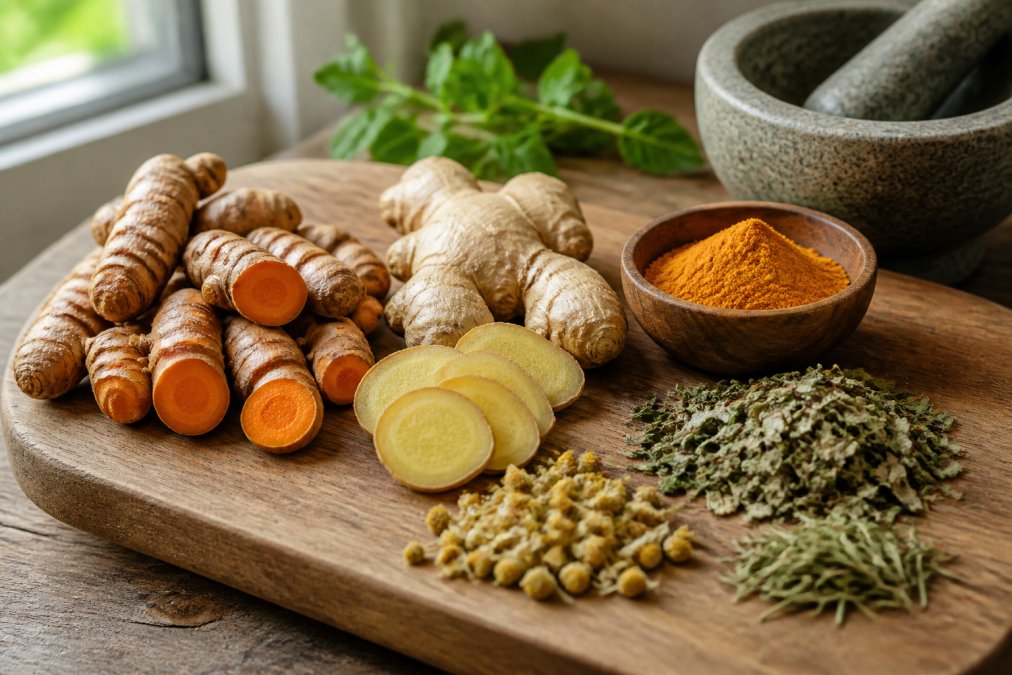
Turmeric (Curcumin)
Curcumin, the golden pigment in turmeric, is the most studied natural compound for inflammation (pubmed.ncbi.nlm.nih.gov). It influences several pathways involved in the inflammatory response, which is why researchers keep returning to it.
The catch is bioavailability. Plain turmeric powder absorbs poorly, and most of what you swallow passes through without being used. Black pepper, fats, and standardized extracts all improve absorption. More on that below.
Ginger
Ginger contains gingerols and related compounds that give it both its bite and its traditional role in supporting joint comfort. It works well in teas, in cooking, and in capsule form, which makes it one of the easiest herbs to add to a daily routine.
Boswellia
Boswellia resin contains boswellic acids, compounds that interact with the same enzyme pathways many anti-inflammatory drugs target, though far more gently. It is traditionally used for joint support and pairs well with turmeric in formulas.
Herbal Support for Joint Health: What Works and What Doesn't
Joint discomfort is not one problem, and the herbs that help depend on which kind you have. Osteoarthritis involves mechanical wear and low-grade inflammation in the cartilage and synovium. Rheumatoid arthritis is an autoimmune attack on the joint lining. Post-activity soreness is acute, short-lived muscle and connective-tissue inflammation. Herbal support behaves differently across all three, and no herb replaces medical treatment for an autoimmune condition.
What the evidence actually supports:
- Boswellia is the most joint-specific herb in this group. Boswellic acids inhibit 5-lipoxygenase, an enzyme in the leukotriene pathway that drives joint swelling (pubmed.ncbi.nlm.nih.gov). Unlike turmeric, boswellia is not heavily dependent on absorption enhancers, though standardized extracts (often labeled for a set percentage of boswellic acids) are more reliable than raw resin.
- Turmeric/curcumin works on the NF-kB and COX-2 pathways, which overlap with the targets of common over-the-counter anti-inflammatories. This is also why it stacks with those medications in a way that requires caution.
- Ginger has modest COX-inhibiting activity and is best positioned for post-activity soreness rather than chronic joint disease.
- Frankincense, peppermint, and clove in topical form do not change joint chemistry. They change sensation: menthol and camphor-like compounds trigger cooling and warming receptors that distract from pain signaling. That is a real effect, but it is symptomatic, not structural.
Topical vs. Internal Applications
Internal herbs work systemically. You take them daily, and the effect builds over weeks. Topical applications work locally: you apply them to a specific knee, shoulder, or lower back, and you feel the result within minutes to hours.
For joint discomfort, many people use both. A tincture or capsule handles the systemic side; an infused oil or salve handles the spot that hurts today. Our Active Essence Herbal Body & Massage Oil ($20.00) combines frankincense, peppermint, and clove for a warming and cooling sensation that makes it a natural fit for post-activity massage. The DualSoothe Warm & Cool Herbal Rub ($8.95) does the same job in a smaller, travel-friendly format.


A practical rule: if the discomfort moves around or follows a whole-body pattern, go internal. If it lives in one joint or one muscle group, go topical first and add internal support only if the topical approach plateaus.
The Safety of Herbal Supplements for Inflammation: What You Need to Know
The safety of herbal supplements for inflammation depends far less on the herb than on the person taking it. Natural does not mean risk-free, and the biggest hazards are interactions, not the plants themselves.
Drug-Herb Interactions
- Turmeric and curcumin can increase the effect of blood thinners and may interfere with some chemotherapy agents.
- Ginger in large doses has mild blood-thinning activity of its own.
- Boswellia may interact with anti-inflammatory medications and, in some reports, with medications processed by the liver.
- St. John's Wort, found in some topical blends, reduces the effectiveness of many prescription drugs, including certain antidepressants and birth control.
If you take prescription medication, particularly for diabetes, blood pressure, or clotting, talk to your prescriber before starting any herbal routine. Bring the actual bottle so they can see the dose.
Contraindications and Side Effects
Herbs are not appropriate for everyone. Skip or get medical clearance if you are pregnant or nursing, scheduled for surgery within two weeks, managing a bleeding disorder, or taking immunosuppressants. Common side effects are usually digestive: stomach upset, reflux, or loose stools. Topical products can cause contact irritation, so patch-test on your inner forearm and wait 24 hours before wider use.
How to Get the Most from Herbal Remedies: Bioavailability and Dosage
Getting real results from herbal remedies comes down to three variables: form, dose, and consistency. Most disappointing outcomes trace back to one of those three, not to the herb being useless.
Why Bioavailability Is the Whole Game for Curcumin
Plain curcumin is poorly absorbed. On its own, most of what you swallow is metabolized in the gut wall and liver before it reaches circulation. Three strategies change that:
- Pair with black pepper. Piperine, the compound that gives black pepper its bite, slows the liver enzymes that clear curcumin. Traditional formulas pair the two for exactly this reason. A pinch of ground black pepper in turmeric tea or a golden-milk recipe is the simplest version of this hack.
- Pair with fat. Curcumin is fat-soluble. Coconut oil, ghee, whole milk, or a plant-based alternative with fat content gives it something to dissolve into. Turmeric in plain water absorbs poorly; turmeric in a fatty base absorbs meaningfully better.
- Choose a standardized extract with a built-in enhancer. Many curcumin products now include piperine, a phospholipid carrier, or a micronized form.
Reading a Supplement Label Like a Practitioner
Dosage and Form
| Form | Best For | Typical Use | Onset |
|---|---|---|---|
| Standardized extract | Consistent daily dosing | Once or twice daily with food | 2-6 weeks |
| Tincture | Flexible dosing, faster absorption | 1-2 droppers under the tongue | 1-3 weeks |
| Herbal tea | Gentle daily support | 1-3 cups daily | Gradual |
| Infused oil or salve | Localized joint and muscle comfort | Apply 1-3 times daily | Minutes to hours |
Herbal Teas and Infusions for Inflammation
Condition-Specific Protocols: Using Herbal Remedies for Inflammation
Frequently Asked Questions
What are the most effective herbs for reducing systemic inflammation?
Turmeric (curcumin), ginger, and boswellia have the strongest evidence. Curcumin shows anti-inflammatory effects by blocking cytokines, while gingerols in ginger work similarly. Boswellic acids target joint comfort. Standardized extracts with enhanced bioavailability, such as curcumin paired with black pepper, work better than plain powders. Always check with your healthcare provider before starting any herbal remedies, especially if you take medications.
Can herbal remedies safely support joint comfort and flexibility?
Some herbs, including boswellia and ginger, may support joint comfort by reducing inflammation markers. Topical options like capsaicin or salicin from willow bark can provide localized relief. However, safety depends on proper dosage and avoiding interactions with blood thinners or other drugs. Herbal support for joint health works best alongside medical care, not as a replacement. Consult a qualified professional to ensure safety.
Are there FDA-regulated standards for herbal supplements?
The FDA regulates herbal supplements as dietary supplements under the Dietary Supplement Health and Education Act (DSHEA) of 1994. Unlike prescription drugs, supplements do not need pre-market approval for safety or effectiveness. The FDA can take action if a product is unsafe or mislabeled. Look for third-party testing seals like USP or NSF to verify quality and standardized extracts. Always buy from reputable sources.
How should I integrate herbal remedies with my current health plan?
Talk to your doctor or pharmacist before adding any herb, especially if you take prescription medications. Keep a list of all supplements and their dosages. Start with one herb at a time to monitor effects. Herbal remedies can complement your health plan but should not replace prescribed treatments. For personalized guidance, consider working with an RN-led herbalist who can review your full health picture.
What is the role of kitchen herbalism in managing daily discomfort?
Kitchen herbalism uses common culinary herbs and spices, like turmeric, ginger, and rosemary, in teas, oils, or balms for everyday support. It focuses on gentle, consistent use rather than high-dose supplements. For example, adding turmeric to soups or steeping ginger tea can support your body's inflammation response. While not a cure, it offers a safe, affordable way to incorporate natural anti-inflammatory herbs into your routine.


Leave a comment