
How to Use Herbal Support for Cycle Regulation and Fertility
Last Updated: October 29, 2026
Quick Summary
Herbal support for cycle regulation and fertility means using plant-based preparations such as teas and tinctures to support menstrual regularity and reproductive health, but no herb has been proven to treat infertility. Treat herbs as supportive tools, not cures, and track your cycle for two to three cycles before judging any change.
- Vitex is the most studied herb for cycle regularity, though its effects remain suggestive rather than proven.
- Track at least two full cycles before starting an herb so you know your baseline.
- Give any herb two to three cycles before judging whether it changed anything.
- Skip herbs if you are pregnant, nursing, or preparing for fertility treatment.
- See a doctor if cycles are consistently shorter than 21 days or longer than 35.
Table of Contents
- Building Your Herbal Support Framework: What to Know First
- Herbs for Menstrual Cycle Regulation: What the Research Shows
- Herbs for Fertility: Separating Tradition from Proven Treatment
- Menstrual Cycle Tracking for Fertility: Measuring What Changes
- Herb Safety and Medication Interactions: What to Check Before You Start
- When Irregular Cycles Need Medical Evaluation
- Choosing an RN-Led Herbal Approach for Your Next Step
- Frequently Asked Questions
Building Your Herbal Support Framework: What to Know First
Herbal support for cycle regulation and fertility is the use of plant-based preparations, such as teas and tinctures, to support menstrual regularity and reproductive health.
That evidence has limits. A review of herbal medicine and female infertility published in PubMed Central (2021) describes how certain plants have been studied for possible effects on fertility, but it reports no confirmed clinical outcome.
Setting Realistic Expectations from the Evidence
Here is what most guides get wrong. They present traditional use as if it were proof.
The Mayo Clinic's guidance on herbs and fertility is blunt: medical literature does not support herbs or supplements as an infertility treatment.
So treat herbs as supportive tools, not cures. Track your cycle. Keep your doctor informed. Expect gradual shifts over two to three cycles, not overnight change.
Herbs for Menstrual Cycle Regulation: What the Research Shows
Vitex, also called chasteberry, is the most studied herb for cycle regularity. The research is promising but not settled. Some sources suggest vitex may help restore hormonal balance in women with PCOS, leading to more regular periods, though this remains suggestive rather than proven.
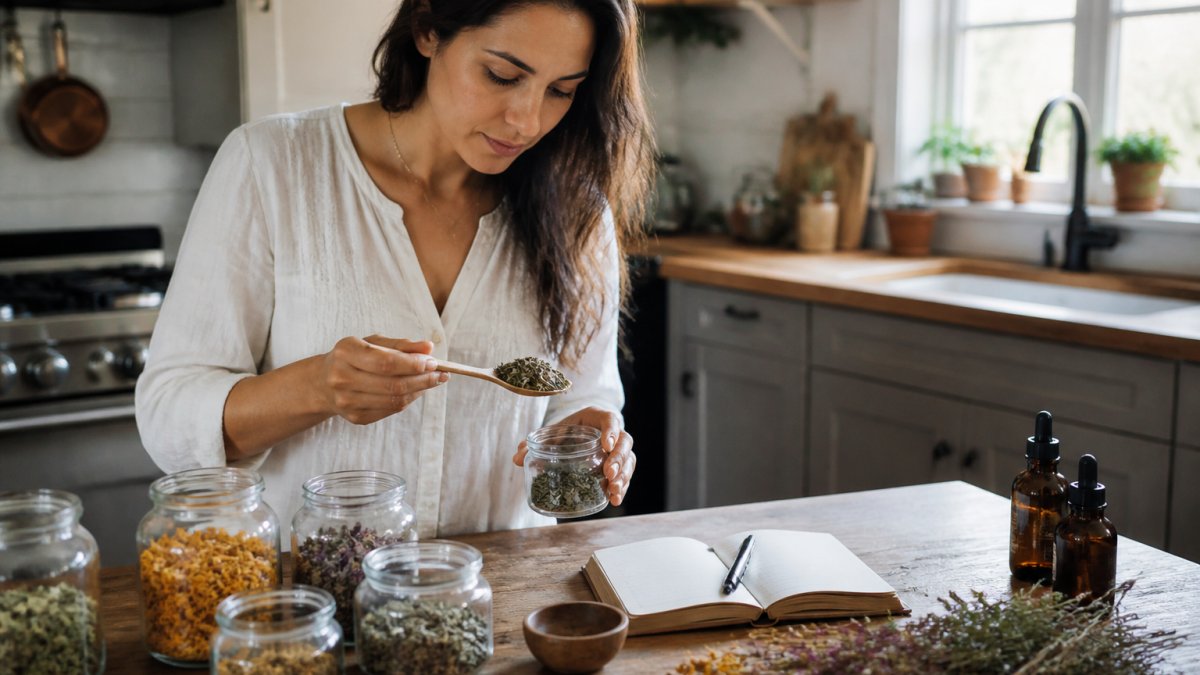
Vitex (Chasteberry) and Cycle Support
Vitex is discussed in traditional and preliminary research as an herb that may influence hormonal signaling.
Vitex is most often discussed in relation to the prolactin and dopamine signaling pathways, which are studied in connection with cycle irregularity.
That mechanism also explains the cautions. Because vitex touches dopamine and prolactin signaling, it can interact with dopamine-active medications, prolactin-lowering drugs, and hormonal contraceptives.
Changes, when they occur, are generally gradual rather than immediate.
Other Traditional Botanicals for Menstrual Regularity
Several herbs carry long histories in women's health. None of them is a proven cycle regulator, but each has a distinct traditional role:
- Red raspberry leaf, a traditional herb often consumed as a tea; it is not a substitute for medical evaluation of irregular bleeding.
- Dong quai, a traditional Chinese herb; it carries bleeding-related cautions and should be discussed with a clinician before use alongside blood thinners.
- Ginger, a familiar culinary herb in this group.
Our Five Botanicals A Woman's Traditional Tincture combines chaste tree berries, dong quai, black cohosh, red clover, and ashwagandha in one traditional blend, crafted in a traditional herbal style.

A Practical Framework for Trying a Cycle-Support Herb
Most guides skip the boring part: how to actually run a fair trial on yourself. A workable approach looks like this:
- Pick one herb and one preparation. A single tincture or a single tea is easier to evaluate than a multi-herb blend, because a blend makes it impossible to tell what helped or what caused a side effect.
- Set a baseline first. Track at least two full cycles before you start so you know what "normal" looks like for you.
- Hold the dose steady. Changing dose mid-trial muddies the signal.
- Give it two to three cycles. Cycle changes are slow, and stress alone can delay ovulation by a week or more.
- Stop and reassess if you notice new symptoms, a missed period, or anything that worries you.
This is the difference between traditional use and a real experiment: tradition tells you an herb has a history; tracking tells you whether it is doing anything for you.
Herbs for Fertility: Separating Tradition from Proven Treatment
No herb has been proven to treat infertility. That sentence should guide every decision you make here.
The American Society for Reproductive Medicine's committee opinion on optimizing natural fertility (2022) focuses on evidence-based steps: timing, lifestyle, and clinical evaluation. Herbs do not replace those steps.
Maca, Ashwagandha, and Adaptogenic Herbs
Adaptogens are a traditional category of herbs discussed in relation to stress. Stress can affect the menstrual cycle, which is why some people consider stress management part of their overall approach. Regulating the body's response to these pressures requires a measured approach to safely using herbs, which remains a foundational practice for those seeking long-term hormonal balance.
- Maca root is a traditionally used root
- Ashwagandha is a traditionally used herb
- Holy basil is a traditionally used herb
You can view our Ashwagandha Root Traditional Ayurvedic Tincture if you want to explore this herb directly.
Menstrual Cycle Tracking for Fertility: Measuring What Changes
Menstrual cycle tracking for fertility means recording cycle length, ovulation signs, and symptoms so you can see real patterns instead of guessing. Without tracking, you cannot tell whether an herb helped.
Five Botanicals A Woman's Traditional Tincture →
What to Track and How to Interpret It
Log these every cycle:
- Cycle length, from day one of bleeding to the next
- Ovulation signs, such as cervical mucus changes
- Basal body temperature, taken before getting out of bed
Give any change at least three cycles before judging it. Cycles shift slowly, and stress alone can delay ovulation.
Herb Safety and Medication Interactions: What to Check Before You Start
Herb safety and medication interactions deserve more attention than most guides give them. Herbs are active plant compounds, and they can interact with prescriptions. The gap in most articles is specificity: they say "check with your doctor" and stop there. Here is what that conversation should actually cover.
Herb-Specific Cautions Worth Knowing
These are commonly cited concerns, not a complete interaction database. Use them to ask better questions, not to self-clear.
- Vitex (chasteberry): may interact with dopamine-active drugs, prolactin-lowering medications, and hormonal contraceptives. Avoid combining with prescription fertility medications without your reproductive endocrinologist's approval.
- Dong quai: a blood-moving herb in traditional Chinese practice; commonly avoided alongside anticoagulants and antiplatelet drugs, and typically not used during heavy bleeding.
- Black cohosh: has been associated with rare liver concerns; avoid if you have a history of liver disease, and stop if you develop jaundice, dark urine, or unexplained fatigue.
Pregnancy, Breastfeeding, and Fertility Treatment
Skip herbs if you are pregnant, nursing, or preparing for fertility treatment. Avoid them if you have a hormone-sensitive condition or take blood thinners. When in doubt, ask your provider first.
The fertility-treatment point is the one most readers underestimate. If you are in the middle of an IVF or ovulation-induction cycle, the medication schedule is tightly timed, and an herb that shifts prolactin or estrogen signaling can complicate the picture your clinician is trying to read.
A Framework for the Clinician Conversation
Before starting anything, run through this:
- Tell your doctor every herb and dose, bring the label, not a memory
- Ask your pharmacist to check interactions with blood thinners, diabetes medication, thyroid medication, and hormones
- Disclose fertility medications and hormonal contraceptives specifically
- Avoid herbs during pregnancy unless your provider approves
If you take medication for diabetes, blood pressure, or thyroid disease, this step is not optional. Our guide to evaluating quality standards for herbal remedy sourcing explains how to judge what you buy, which matters here, because an unlabeled blend makes an interaction check impossible.
Contraindications and When to Avoid Herbs
Beyond pregnancy and nursing, the clearest reasons to avoid a given herb are: a hormone-sensitive condition (red clover, and caution with any phytoestrogen), anticoagulant or antiplatelet therapy (dong quai, concentrated ginger), liver disease history (black cohosh), and thyroid or blood-sugar medication (ashwagandha). If you are preparing for fertility treatment, treat herbs as something to clear with your care team rather than something to add quietly.
Here are the herb-specific cautions the article flags, so you can bring better questions to your clinician.
| Herb | Commonly cited concern |
|---|---|
| Vitex (chasteberry) | May interact with dopamine-active drugs, prolactin-lowering medications, hormonal contraceptives |
| Dong quai | Blood-moving herb; avoided alongside anticoagulants and antiplatelet drugs |
| Black cohosh | Associated with rare liver concerns; avoid with liver disease history |
| Red clover | Phytoestrogen; caution with hormone-sensitive conditions and tamoxifen |
| Ashwagandha | Discussed with thyroid and blood-sugar medications |
| Ginger and cinnamon | Concentrated extracts can interact with some medications |
When Irregular Cycles Need Medical Evaluation
See a doctor if your cycles are consistently shorter than 21 days or longer than 35, if you skip periods for three months or more, or if bleeding is very heavy or painful. Those signs point to conditions herbs cannot address.
If your cycle changes are tied to midlife hormonal shifts, our article on 8 best herbs for perimenopause support covers that stage in more detail.
Choosing an RN-Led Herbal Approach for Your Next Step
Herbal support works best when someone who understands both plants and medicine guides you. That is the difference an RN-led approach makes.
If you are building a hormonal support plan, our 2026 guide to managing hormonal imbalance with herbs walks through it step by step.
Here is your challenge: stop guessing and start tracking. Then choose herbs with clear intent.
HighFiveHive Nature's Remedies-Kitchen Herbalism offers RN-led herbal remedies, kitchen herbalism crafted with care, and women's wellness support built on real clinical experience.
Frequently Asked Questions
What herbs may support menstrual cycle regularity?
Vitex (chasteberry) is the most discussed herb in relation to cycle regularity, and research on it in women with PCOS is preliminary. Other traditionally used herbs include red raspberry leaf, nettle, ginger, and cinnamon. The evidence for most herbs remains preliminary, so treat them as supportive additions rather than proven treatments. Track your cycle for three months to see whether your pattern changes, and discuss any persistent irregularity with a healthcare professional.
Can herbs improve fertility or help you get pregnant?
No herb has been shown in medical literature to treat infertility. The Mayo Clinic states there is no evidence supporting herbs or supplements as an infertility treatment. Some herbs are traditionally associated with fertility, such as maca and ashwagandha, and are the subject of preliminary research, which does not establish any effect on conception. Herbal support may complement a healthy lifestyle, but anyone trying to conceive should have a clinical evaluation and use herbs only with professional guidance.
Are herbal supplements safe while trying to conceive?
Safety depends on the specific herb, dose, and your health history. Some herbs are contraindicated during pregnancy or when trying to conceive, and others can interact with fertility medications or birth control. Before starting any herbal supplement, review it with your healthcare provider or a clinical herbalist who can check for interactions. Choose products from transparent sources, follow label directions, and stop use if you notice unexpected symptoms. Never replace prescribed fertility treatment with herbs.
When should I talk to a healthcare professional about irregular periods or fertility?
Seek evaluation if your cycles are consistently shorter than 21 days or longer than 35 days, if you skip periods for three months or more, if bleeding is unusually heavy or painful, or if you have been trying to conceive for 12 months without success (6 months if you are over 35). These signs can point to conditions such as PCOS, thyroid disorders, or other treatable issues. A healthcare professional can order appropriate testing and help you build a safe plan that may include herbal support.


Leave a comment