
Herbal Remedies vs Prescription Medication: What to Know
Table of Contents
- How Herbal Remedies and Prescription Medication Differ
- FDA Regulation of Dietary Supplements vs. Prescription Drugs
- Herbal Supplement Drug Interactions You Need to Know
- Natural Diabetes Management Strategies and Prescription Options
- The Myth of Natural Always Being Safe
- How to Read a Supplement Label and Choose Quality Products
- Cost, Bioavailability, and Integrative Approaches
- Frequently Asked Questions
Last Updated: September 13, 2026
How Herbal Remedies and Prescription Medication Differ
Herbal remedies vs prescription medication is not a contest with one winner, but a comparison between two regulatory systems, two dosing philosophies, and two very different levels of oversight. This guide from HighFiveHive Nature's Remedies-Kitchen Herbalism breaks down what separates them and what to check before you combine the two.
The core difference is control. A prescription drug contains a single, purified active ingredient produced to a fixed standard, and the FDA reviews its safety and effectiveness before it reaches a pharmacy. An herbal remedy contains one or more plants whose active constituents shift with soil, harvest, and extraction method.
Herbal medicine uses plant material, leaves, roots, flowers, berries, for health support, and is regulated as dietary supplements rather than drugs. That single fact shapes everything else here.
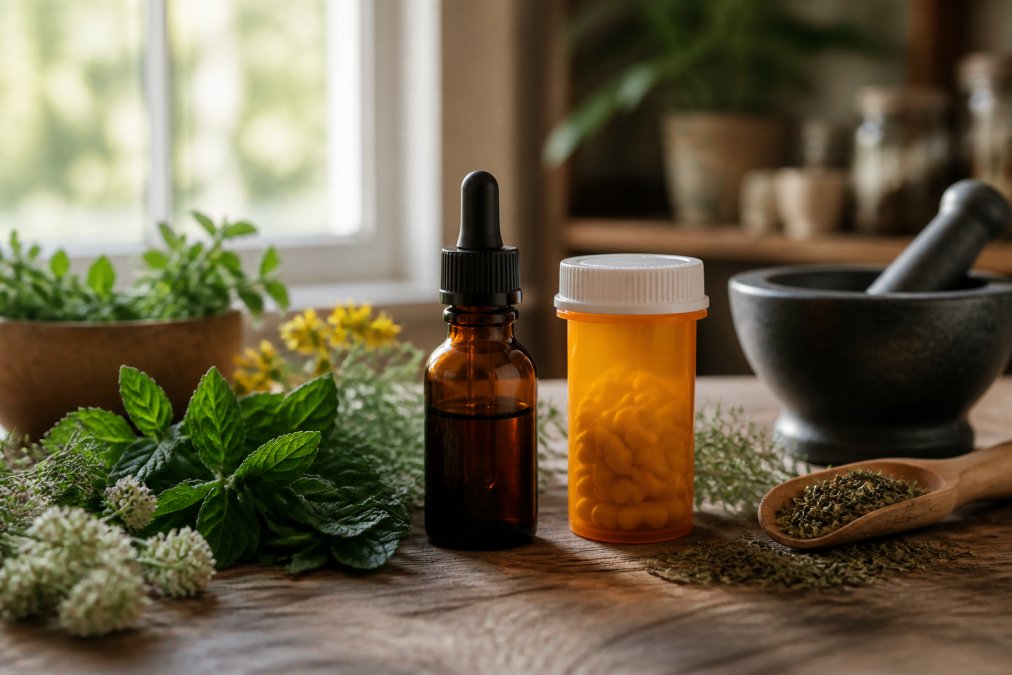
Active Ingredients: Standardized vs. Variable
A prescription tablet is standardized by law: every pill contains the same amount of the same molecule. A botanical preparation is not, unless the label says so. Standardized extracts are adjusted to a marker compound, while whole-plant tinctures and teas vary by batch by design, not automatically a flaw, but it means two bottles of the same herb can behave differently.
How the Body Processes Each Option
Pharmacokinetics, how a substance is absorbed, distributed, metabolized, and excreted, differs sharply. Purified drugs follow predictable, reproducible curves. Botanical preparations contain multiple bioactive compounds that can compete for the same liver enzymes, making metabolism and interactions harder to predict.
FDA Regulation of Dietary Supplements vs. Prescription Drugs
FDA regulation of dietary supplements works differently from drug approval, and the gap is wider than most people assume. Prescription drugs must go through clinical trials and premarket approval before they can be sold. Dietary supplements do not. Under the framework described by the FDA's dietary supplement guidance, a supplement can be marketed without proving effectiveness first, and the agency's role is largely reactive: it can act after a product proves unsafe, not before.
That is why two products on the same shelf can carry wildly different evidence. A prescription arrives with a tested safety profile, a defined dose, and known contraindications. A supplement arrives with a label and a manufacturer's assurance.
| Feature | Prescription Medication | Herbal Supplement |
|---|---|---|
| Pre-market approval | Required | Not required |
| Active ingredient | Purified, single compound | Often multiple botanicals |
| Dose consistency | Fixed by law | Varies by product |
| Effectiveness proof | Clinical trials required | Not required |
| Interaction warnings | Mandatory labeling | Often limited |
| Manufacturing oversight | cGMP enforced pre-market | cGMP required, enforcement reactive |
What the FDA Does and Does Not Do
The FDA does require supplement makers to follow current Good Manufacturing Practices (cGMP), covering facility cleanliness, ingredient identity testing, and batch records. What cGMP does not require is proof the product works for the condition on the label. A manufacturer can follow cGMP perfectly and still sell a product with no clinical evidence. The FDA polices how supplements are made, not whether they help.
The agency also maintains a Dietary Supplement Ingredient Advisory List of ingredients it has flagged as potentially unlawful or unsafe. Checking that list before buying an unfamiliar botanical is a five-minute step most shoppers skip.
Third-Party Testing Seals: The Practical Workaround
Because the FDA does not verify what is inside a bottle before sale, independent certifiers fill the gap. Three seals matter:
- USP Verified Mark, issued by the United States Pharmacopeia. Confirms the product contains the ingredients listed, in the declared amounts, and passes contaminant screening.
- NSF Certified for Sport, issued by NSF International. Stricter than the general NSF mark; screens for athletic-banned substances and is the seal most relevant if you are subject to drug testing.
- ConsumerLab.com, a subscription testing service rather than an on-bottle seal. Useful for checking a specific brand before you buy.
A product with none of these seals is not automatically unsafe, but it is unverified. One with a seal has had an independent lab confirm identity, potency, and purity, the three things the FDA does not check before sale.
Where Prescription Oversight Still Has Gaps
It is worth noting the comparison is not one-sided. The FDA's post-market surveillance system for approved drugs, including the FDA Adverse Event Reporting System (FAERS), relies heavily on voluntary reporting, and many drug interactions are discovered only after a medication has been on the market for years. Prescription status means the drug was tested before approval; it does not mean every interaction was known at approval. The practical takeaway is the same for both categories: report side effects, and tell every provider what you take.
Herbal Supplement Drug Interactions You Need to Know
Herbal supplement drug interactions are the most underrated risk in this comparison. Because botanicals contain multiple active constituents, they can alter how your body breaks down prescription drugs, sometimes speeding a drug up, sometimes slowing it down, leaving a blood level that drifts from what your prescriber intended.
The practical rule: tell your pharmacist about every supplement you take, including teas and tinctures. Pharmacists run interaction checks as part of their training and can flag a conflict before it becomes a problem.
St. John's Wort: A Well-Known Example
St. John's Wort is the standard teaching example for a reason. It induces certain liver enzymes, which means it can speed the breakdown of other medications and reduce their effect. Antidepressants, birth control pills, blood thinners, and transplant medications are all documented concerns. The National Center for Complementary and Integrative Health on St. John's Wort notes that these interactions can be serious. Our own Golden Comfort St. John's Wort Tincture carries the same warning on its label, and we mean it: do not use it internally without clearing it with your doctor or pharmacist first.

Natural Diabetes Management Strategies and Prescription Options
Natural diabetes management strategies do not replace insulin or prescribed glucose-lowering medication, and any source that says otherwise is selling something. They can sit alongside a treatment plan as complementary support, with your care team's knowledge. Blood sugar management is where self-medication carries real risk, because the feedback loop is slow and the consequences of drifting out of range are cumulative.
A sensible approach looks like this:
- Confirm your current A1C and medication list with your provider
- Ask which botanicals, if any, are safe alongside your prescriptions
- Start one product at a time, not several at once
- Log any change in readings or how you feel
- Bring your log to your next appointment
At HighFiveHive Nature's Remedies-Kitchen Herbalism, we built our approach around this sequence, because forty years of nursing taught us that the plan matters more than the plant.
The Myth of Natural Always Being Safe
Natural does not mean safe, and this is where the wellness aisle misleads people most. Hemlock is natural. So is arsenic. The word describes origin, not risk. Botanical medicine includes plants with genuine pharmacological activity, exactly why they can help and why they can harm.
Adverse effects from herbal products are underreported, partly because users rarely connect a symptom to a supplement started weeks earlier. Toxicology does not care whether a compound came from a lab or a leaf. What matters is dose, preparation, and your individual metabolism.
How to Read a Supplement Label and Choose Quality Products
Reading a supplement label correctly filters out most low-quality products in under a minute. Look for four things: the botanical's scientific name, the plant part used, the amount per serving, and a manufacturing standard. If the label says "proprietary blend" without amounts, you cannot know what you are taking.
Quality markers worth checking:
- Botanical name in Latin, not just the common name
- Plant part specified, such as root, leaf, or flowering top
- Extraction method and alcohol or water base listed
- Batch or lot number for traceability
- Third-party purity testing mentioned
Our Five Botanicals: A Woman's Traditional Tincture lists all five plants by name and part, extracted in organic alcohol and water, because a label you can read is the first safety check.
Cost, Bioavailability, and Integrative Approaches
Bioavailability, dosage accuracy, and cost are the gaps most comparisons skip. Together they explain why the herbal-vs-prescription decision is rarely about which is "better" and almost always about which combination a patient can sustain.
Bioavailability: Why the Delivery Form Matters
Bioavailability is the fraction of a dose that reaches your bloodstream in active form, and delivery form changes it substantially:
- Tinctures, alcohol- or glycerin-based liquid extracts. Absorbed quickly through the mucous membranes and stomach lining, which is why effects can be felt within 15 to 30 minutes. Alcohol-based tinctures generally extract a broader range of plant compounds than glycerin alone.
- Capsules and tablets, dried, powdered plant material. Must be broken down in the stomach first, so onset is slower and absorption depends on what else is in the digestive tract.
- Teas and infusions, the gentlest and most variable. Water extracts a narrower set of compounds than alcohol, and steeping time, water temperature, and plant part all shift the dose.
- Standardized extracts, adjusted to a marker compound so each dose is consistent. The trade-off is that the marker compound may not be the one doing the work.
A common pattern: a patient who feels nothing from a capsule may respond to the same herb as a tincture, or vice versa. That is not placebo, it is the delivery form changing how much active constituent arrives.
The Cost Picture for Chronic Conditions
For an occasional upset stomach, cost is trivial. For a condition managed daily for years, it is not:
- A single-herb tincture typically runs $15 to $25 for a one- to two-ounce bottle, which at a standard dropper dose lasts roughly three to six weeks. That works out to roughly $10 to $30 per month for one herb.
- A chronic prescription often carries a monthly copay that varies widely by insurance plan, drug tier, and whether a generic exists. Generic medications are frequently cheaper per month than a comparable herbal regimen; brand-name medications frequently are not.
- Herbal regimens for a single condition often stack two to four products, which multiplies the monthly cost. A prescription is usually one product.
The honest framing is not which is cheaper in the abstract, but which combination your provider can monitor and whether the total monthly cost, including any lab work the herbal approach requires, fits your budget long term.
What Integrative Medicine Actually Looks Like
Integrative medicine, the practice of combining conventional treatment with evidence-informed complementary approaches, is where this comparison lands for most people. The CDC's guidance on complementary health approaches points patients toward open conversation with their providers rather than choosing one path in secret.
A workable integrative plan has four parts:
- One change at a time. Add or remove a single product, then wait at least two weeks before the next change. Stacking changes makes it impossible to know what helped or what caused a side effect.
- A shared medication list. Every prescriber and your pharmacist should see the same list, including teas, tinctures, and topicals.
- A monitoring marker. For blood sugar, that is A1C or daily readings. For blood pressure, it is a home cuff log. For mood, it is a validated screening tool your provider uses. Without a marker, you are guessing.
- A stop rule. Decide in advance what result would tell you the herbal addition is not working, and what symptom would tell you to stop immediately.
The most expensive outcome is not the herbal product or the prescription, it is an unmonitored interaction that sends you to an emergency room. Cost comparisons only matter after safety is handled.
At HighFiveHive Nature's Remedies-Kitchen Herbalism, we built our approach around this sequence, because forty years of nursing taught us that the plan matters more than the plant.
Frequently Asked Questions
Do herbs actually work as medicine?
Some herbs contain bioactive compounds that can affect the body. For example, St. John's Wort has been studied for mild to moderate depression, and ashwagandha is traditionally used for stress support. However, herbal remedies are not standardized like prescription drugs, so potency varies. Clinical trials exist for some herbs, but evidence is mixed. Always talk to your doctor before using herbs to treat a medical condition, especially if you take prescription medication.
Can herbal remedies interact negatively with prescription medications?
Yes. Herbal supplement drug interactions are common and can be serious. St. John's Wort, for instance, reduces the effectiveness of birth control pills, blood thinners, and some antidepressants. Ginkgo may increase bleeding risk when combined with anticoagulants. Always tell your pharmacist and doctor about every herb, tea, or tincture you use. They can check for contraindications and help you avoid adverse effects.
How does the FDA regulate herbal supplements compared to prescription drugs?
FDA regulation of dietary supplements differs from prescription drugs. Prescription medications must undergo clinical trials for safety and efficacy before approval. Herbal supplements are regulated as dietary supplements, meaning they can be sold without pre-market approval. The FDA can act if a product is unsafe or mislabeled, but it does not verify ingredients or dosage before sale. This is why third-party purity testing and standardized ingredients matter.
What should I discuss with my healthcare provider before starting herbal support?
Bring a list of all prescription medications, over-the-counter drugs, and supplements you take. Ask about potential drug interactions, contraindications, and whether the herb affects your condition. For natural diabetes management strategies, discuss how herbs might impact blood sugar and interact with insulin or oral medications. Your provider can help you integrate herbal support safely with evidence-based medicine.
Are there natural diabetes management strategies that work alongside prescription medication?
Some people use herbal teas, dietary changes, and lifestyle adjustments to support blood sugar control. However, these should complement, not replace, prescribed medication. Herbs like cinnamon or bitter melon may have mild effects, but research is limited. Always monitor your blood sugar closely and consult your doctor before adding any herbal remedy. Integrative approaches work best when your healthcare team is involved.
Managing a chronic condition is hard enough without guessing whether the bottle in your cabinet is helping or quietly working against your prescription. HighFiveHive Nature's Remedies-Kitchen Herbalism was built to remove that guesswork: RN-led formulations, forty years of nursing experience behind every blend, and labels that tell you exactly what is inside. Explore our tinctures and teas, then bring the ingredient list to your next appointment and start the conversation.


Leave a comment