
How to Verify Herbalist Credentials: A 2026 Guide
Table of Contents
- Is Herbalism a Regulated Profession in the US?
- American Herbalists Guild Registered Herbalist Requirements
- How to Verify Herbalist Credentials: A Step-by-Step Process
- Red Flags in Herbalist Marketing to Watch For
- How to Find a Qualified Herbalist Near You
- Why an RN-Led Approach to Verify Herbalist Credentials Matters
- Conclusion
Last Updated: August 5, 2026
Is Herbalism a Regulated Profession in the US?
Herbalism is not a licensed or regulated profession in the United States at the federal level. No federal agency oversees the practice of clinical herbalism, and no state currently issues a license specifically for herbalists. This is the most important fact to understand before you search for a practitioner: the title "herbalist" carries no legal definition in American healthcare law.
That reality puts the burden of verification squarely on you, the consumer. Unlike seeing a physician, nurse practitioner, or licensed acupuncturist, consulting an herbalist requires you to do your own credential checking. This guide from HighFiveHive Nature's Remedies-Kitchen Herbalism walks you through exactly how to do that, what credentials actually mean, and how to spot practitioners who misrepresent their qualifications.
According to the National Center for Complementary and Integrative Health's overview of herbal medicine, botanical medicine is used by a significant portion of American adults, yet the field operates largely outside formal regulatory oversight. That gap between widespread use and minimal regulation is precisely why knowing how to verify herbalist credentials matters.
Certification vs. Licensure: What the Difference Actually Means
Licensure is a government-issued authorization to practice. It carries legal force: practicing without it is illegal. Physicians, registered nurses, and pharmacists hold licenses.
Certification is granted by a private organization and signals that a practitioner has met that organization's educational and competency standards. It carries professional weight but no legal authority. An herbalist can practice without any certification at all, which is entirely legal.
Understanding this distinction protects you. A practitioner calling themselves "certified" has met a private standard. A practitioner calling themselves "licensed" in herbalism specifically is either misstating their credentials or referring to a different license entirely, such as a nursing or naturopathic license.
The Role of Self-Regulation and Health Freedom Laws
Most states have enacted some form of health freedom legislation that explicitly permits unlicensed individuals to provide complementary health services, including herbal consultations, as long as they clearly disclose that they are not licensed healthcare providers. The National Health Freedom Coalition's state law tracker maintains a current map of these statutes, which vary considerably in their requirements.
Self-regulation through professional membership organizations is the primary quality control mechanism in herbalism. This is not a perfect system, but it is the existing one. Knowing which organizations set the most rigorous standards is your first practical tool.
American Herbalists Guild Registered Herbalist Requirements
The American Herbalists Guild is the most recognized professional body for herbalists in the United States. Founded in 1989, the AHG awards the designation Registered Herbalist (RH), which represents the field's closest equivalent to a professional credential.
Earning the RH designation is not a simple process. The AHG's requirements are among the most stringent in the field, and relatively few practitioners hold the designation. If a practitioner lists AHG-RH after their name, that is a meaningful signal of serious professional commitment.
Educational and Clinical Hours Standards
The AHG requires applicants to demonstrate comprehensive training in herbal pharmacology, botany, and clinical practice. According to the American Herbalists Guild's peer review requirements, candidates must document a minimum of 400 hours of formal herbal education and 400 hours of supervised clinical experience working directly with clients.
The educational component must cover:
- Materia medica (the study of herbal medicines and their properties)
- Herbal pharmacology and safety protocols
- Botany and plant identification
- Clinical assessment and intake procedures
- Informed consent and scope of practice boundaries
The clinical hours requirement is what separates the AHG standard from many certificate programs. Supervised clinical experience means working with real clients under the oversight of a more experienced practitioner, not simply completing coursework.
Continuing Education and Professional Ethics Obligations
Holding the RH designation is not a one-time achievement. Registered Herbalists must complete continuing education hours each renewal cycle and adhere to the AHG's code of professional ethics. That code addresses informed consent, scope of practice, referral obligations, and honest representation of credentials.
This matters for consumers because it means an AHG-RH practitioner has agreed to a set of professional standards that can be enforced by the organization. If a Registered Herbalist behaves unethically, clients can file a complaint with the AHG. That accountability mechanism does not exist for uncredentialed practitioners.
How to Verify Herbalist Credentials: A Step-by-Step Process
Verifying herbalist credentials requires a methodical approach because no single government database exists for this purpose. Work through these steps in order.
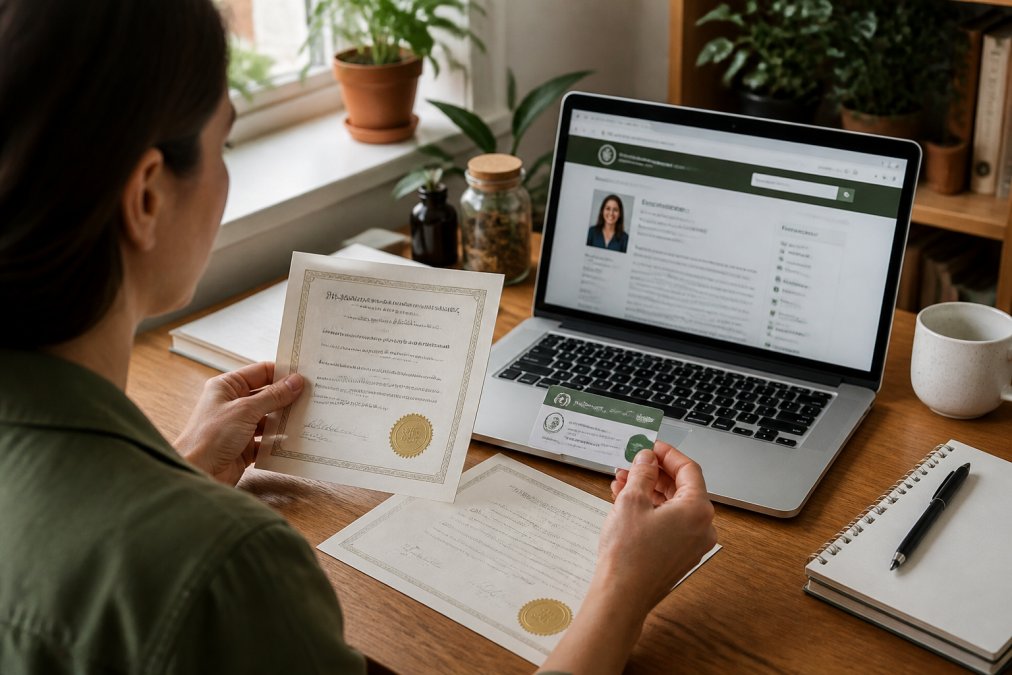
Step 1: Ask directly for their credentials in writing. Request a written summary of their formal herbal education, clinical hours completed, any certifications held, and membership in professional organizations. A qualified practitioner will provide this without hesitation. Vague or evasive responses are a warning sign.
Step 2: Search the AHG's public directory. The American Herbalists Guild maintains a searchable directory of current Registered Herbalists at their official website. Confirm the practitioner's name appears there and that their membership is active, not lapsed.
Step 3: Verify any other professional licenses independently. Some herbalists also hold nursing licenses, naturopathic licenses, or acupuncture licenses. These are verifiable through your state's professional licensing board. Each state maintains a public license lookup tool. If a practitioner claims to be a Registered Nurse or Licensed Naturopathic Doctor, verify that claim through the state board directly, not through the practitioner's own website.
Step 4: Check their educational institution's accreditation. Ask which school or program they completed. Reputable herbal training programs will be transparent about their curriculum hours and faculty credentials. Some programs are accredited by the Accreditation Commission for Acupuncture and Herbal Medicine, which provides an additional layer of third-party oversight.
Step 5: Look for a clear scope of practice statement. A trustworthy practitioner will explicitly state what they do and do not do. They should not diagnose medical conditions, prescribe medications, or promise cures. If their website or intake forms include clear scope of practice language and informed consent documentation, that is a positive indicator.
Step 6: Check for complaint history. For any additional professional licenses, search your state licensing board for disciplinary actions. For AHG members, contact the organization directly if you have specific concerns.
| Verification Step | Where to Check | Time Required |
|---|---|---|
| AHG Registered Herbalist status | americanherbalistsguild.com directory | 5 minutes |
| State professional license (RN, ND) | State licensing board website | 5-10 minutes |
| Educational program credibility | Program's own website + ACAOM database | 10-15 minutes |
| Scope of practice statement | Practitioner's website or intake forms | 5 minutes |
| Written credential summary | Direct request to practitioner | 1-2 days |
Red Flags in Herbalist Marketing to Watch For
Most guides focus on what good credentials look like. Here is what bad ones look like, because the warning signs are often hiding in plain sight.
Cure claims. No herbalist, regardless of training, can legally or ethically claim that herbal remedies cure diseases. Phrases like "reverses diabetes," "eliminates joint pain permanently," or "cures hormonal imbalance" are not just misleading; they may violate Federal Trade Commission guidelines on health claims. Qualified practitioners use language like "supports," "may help," or "complements."
Vague or invented titles. Titles like "Master Herbalist," "Certified Natural Health Practitioner," or "Doctor of Herbology" sound impressive but often come from unaccredited distance-learning programs with minimal standards. None of these titles are regulated. Always ask what specific organization awarded the designation and what requirements were involved.
No mention of scope of practice. Practitioners who do not clearly state what they cannot do are often overstepping. A qualified herbalist will proactively tell you they are not a substitute for medical care.
Pressure to stop prescribed medications. This is a serious safety red flag. Any practitioner suggesting you discontinue physician-prescribed medications without medical supervision is operating outside appropriate professional ethics. This is especially critical for people managing conditions like diabetes, where medication changes carry real health consequences.
No intake process or health history review. Responsible herbalists conduct thorough intake interviews and review your full health history, including current medications, before making any recommendations. Skipping this step indicates either inexperience or indifference to herb-drug interactions.
How to Find a Qualified Herbalist Near You
Finding a qualified herbalist requires knowing where to look beyond a basic internet search. The AHG's online directory is the most reliable starting point for finding practitioners who have met a meaningful professional standard. You can filter by state and specialty.
A few additional approaches that tend to yield better results than general searches:
- Ask integrative medicine clinics. Many integrative health centers employ or maintain referral relationships with credentialed herbalists. Their vetting process adds a layer of quality assurance.
- Contact naturopathic physicians. Licensed naturopathic doctors (NDs) in states where naturopathic medicine is regulated often have professional networks that include credentialed herbalists.
- Check local herb schools. Established herbal education programs often maintain alumni directories or clinic referral lists for their graduates.
- Look for practitioners with dual credentials. Herbalists who also hold regulated healthcare licenses, such as registered nurses, licensed acupuncturists, or naturopathic doctors, bring an additional layer of verifiable professional accountability.
The most important filter is not the practitioner's marketing copy. It is whether they can answer your credential questions clearly, whether they appear in a verifiable professional directory, and whether their approach to your health history is thorough and careful.
Why an RN-Led Approach to Verify Herbalist Credentials Matters
Here is the part most guides skip entirely: the credential question is not just about the practitioner you consult. It is about whether the person guiding your herbal choices understands the full clinical picture, including your medications, your diagnosed conditions, and the real pharmacology of the plants involved.
This is where an RN-led approach offers something genuinely different. A registered nurse brings a regulated, verifiable credential, a clinical understanding of herb-drug interactions, and a professional obligation to work within an established standard of care. At HighFiveHive Nature's Remedies-Kitchen Herbalism, that foundation is 40 years of nursing experience applied directly to kitchen herbalism, meaning the guidance you receive is grounded in clinical reality, not just traditional knowledge.
The distinction matters most for people managing complex health situations: blood sugar concerns with multiple medications on board, hormonal changes during perimenopause or menopause, or chronic joint discomfort that has not fully responded to conventional approaches. In these situations, herbal recommendations made without clinical context can be ineffective at best and harmful at worst.
An RN-led herbalist does not replace your physician. What they provide is a clinically informed bridge between conventional medical care and botanical medicine, one where informed consent is not a formality but a genuine conversation about what is realistic, what the evidence supports, and what safety protocols apply to your specific situation.
Verifying herbalist credentials in an unregulated field takes more effort than checking a physician's license, but the process is straightforward when you know where to look. The AHG directory, state licensing boards for any dual credentials, and a direct conversation about scope of practice will tell you most of what you need to know. For those managing complex health conditions, working with a practitioner who holds a regulated clinical credential alongside herbal training provides an additional layer of protection that no certification alone can offer. HighFiveHive Nature's Remedies-Kitchen Herbalism brings 40 years of nursing experience to every herbal recommendation, combining RN-level clinical accountability with a kitchen herbalism approach designed for real, everyday wellness. Shop Now to explore what that combination looks like in practice.
Frequently Asked Questions
Can herbalists be licensed or registered in the US?
No US state currently licenses herbalists as a distinct profession. Herbalism sits outside the formal regulatory framework that governs medicine, nursing, or naturopathy. However, practitioners can earn voluntary credentials through professional organizations such as the American Herbalists Guild, which grants the Registered Herbalist (RH) designation to those who meet its educational, clinical, and peer-review standards. Some herbalists also hold licensed healthcare credentials, such as registered nurse or naturopathic doctor, that are state-regulated and verifiable through official licensing boards.
What is the difference between a certified herbalist and a registered herbalist?
A certified herbalist has typically completed a certificate program offered by a school or training organization. Standards vary widely between programs, so the term alone says little about the depth of herbal education or clinical experience involved. A Registered Herbalist (RH) through the American Herbalists Guild has met a defined standard: documented herbal training, supervised clinical hours, professional peer review, and ongoing continuing education requirements. The RH designation is currently the most recognized voluntary credential in the US botanical medicine field.
How can I tell if an herbalist is qualified to give health advice?
Start by asking for their credentials in writing. Look for an AHG Registered Herbalist designation, which you can confirm on the Guild's public directory. Check whether they hold any state-licensed healthcare credentials, such as RN, ND, or PA, that you can verify through your state's licensing board. Ask about their supervised clinical hours, herbal pharmacology training, and professional ethics framework. A qualified practitioner will also ask about your current medications and medical history before recommending any botanical medicine, and will maintain clear informed consent practices.
Does the American Herbalists Guild provide official government credentials?
No. The AHG is a professional membership organization, not a government regulatory board. Its Registered Herbalist credential is a voluntary, peer-reviewed designation rather than a state-issued license. That said, it currently represents the most structured credentialing standard available in US herbalism, requiring documented herbal education, clinical experience, and ongoing professional development. For consumers, AHG membership and the RH designation are meaningful signals of commitment to professional standards, especially in an industry where no federal or state licensure exists for herbalists specifically.
This article was written using GrandRanker


Leave a comment