
What Is Holistic Wellness for Women? A 2026 Guide
Table of Contents
- Defining Holistic Wellness for Women
- Herbal Support for Hormonal Health
- Natural Remedies for Women's Wellness
- A Holistic Approach to Immune Health
- Nutrition, Movement, and Sleep: The Daily Pillars
- Stress, Emotional Well-Being, and Digital Wellness
- Financial Wellness and Life-Stage Planning
- Frequently Asked Questions
Last Updated: September 19, 2026
Defining Holistic Wellness for Women
Holistic wellness for women is a whole-person approach to health that considers physical, mental, emotional, and social factors together rather than treating symptoms in isolation. At HighFiveHive Nature's Remedies-Kitchen Herbalism, we've spent years helping women understand that how you sleep, eat, move, manage stress, and connect with others shapes your health as much as any single treatment.
The National Center for Complementary and Integrative Health overview of whole-person health describes this as addressing the "whole person" rather than one organ system at a time.
That distinction matters. Most women arrive at holistic wellness after conventional care has left them with unanswered questions about fatigue, mood swings, stubborn weight changes, or joint discomfort.
The Mind-Body-Spirit Connection
The mind-body-spirit connection holds that emotional state, mental clarity, and sense of purpose directly influence physical vitality. Chronic stress raises cortisol, which in turn affects sleep quality, blood sugar regulation, and immune response. A woman who feels isolated or burned out will often see that show up as physical symptoms.
This is not abstract philosophy. It is the biopsychosocial model applied to daily life: biology, psychology, and social environment interact, and ignoring any one of them limits how much progress the others can deliver.
How Holistic Wellness Differs From Conventional Care
Conventional care excels at acute problems: infections, fractures, screenings, medication management. Holistic wellness does not replace that. It fills the gap between "your labs are normal" and "you still don't feel well."
An integrative approach layers lifestyle planning, nutritional optimization, stress management, and sleep hygiene on top of whatever medical care you already receive.
Herbal Support for Hormonal Health
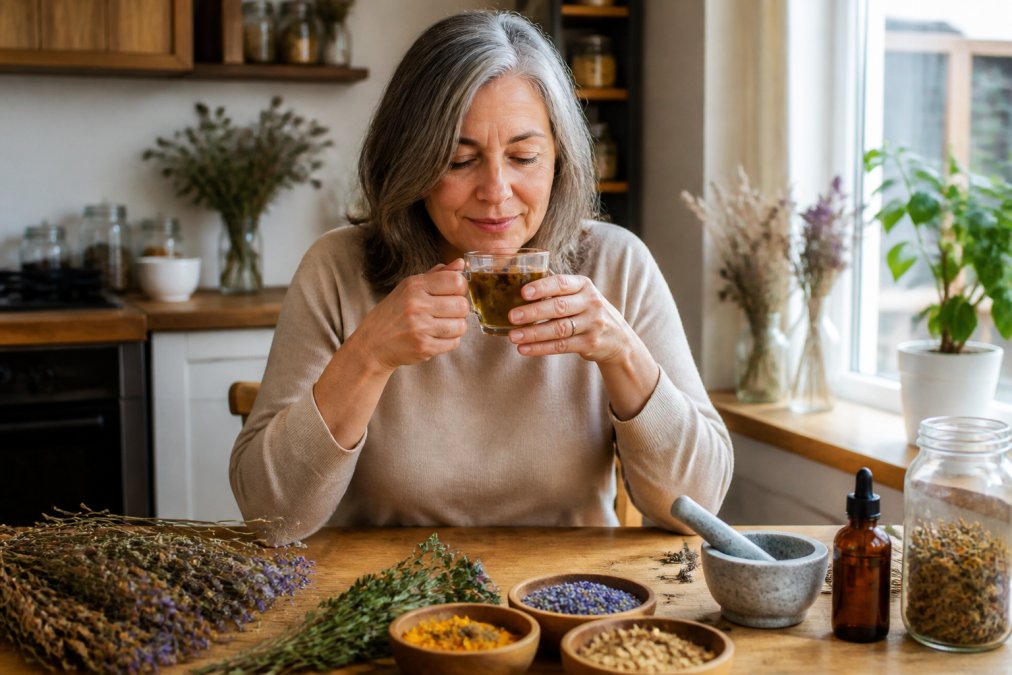
Hormonal balance shifts constantly across a woman's life, and the support that helps at 25 is rarely the support that helps at 52. A holistic approach treats hormonal health as a moving target with distinct phases: the cycling years, perimenopause (the transition into menopause, often beginning in the mid-40s), menopause itself, and post-menopause. Each phase has different dominant symptoms, different risk profiles, and different botanical traditions attached to it.
What Changes Across Each Life Stage
During the cycling years, the dominant hormonal concerns tend to be cycle regularity, premenstrual mood shifts, and iron status. In perimenopause, fluctuating estrogen and progesterone drive hot flashes, sleep disruption, irregular cycles, and mood volatility. Menopause marks twelve consecutive months without a cycle, and post-menopause brings a new set of priorities: bone density, cardiovascular health, and vaginal and urinary tissue changes.
Botanicals Traditionally Used for Women's Balance
Five botanicals appear repeatedly in traditional preparations for women, and each has a distinct traditional role:
- Black cohosh, long used in preparations for hot flashes and night sweats during the menopausal transition.
- Dong quai, a staple of traditional preparations for cycle support and blood-building.
- Ashwagandha, an adaptogen traditionally used for stress resilience and sleep quality, both of which influence hormonal symptoms.
- Red clover, contains isoflavones, plant compounds studied for their mild estrogen-like activity.
- Chaste tree berries (vitex), traditionally used for premenstrual symptoms and cycle regularity.
How to Evaluate a Botanical Product
Not all herbal products are equivalent, and the differences matter more than the label copy suggests. Three things are worth checking before you buy:
- The plant part used. Roots, berries, and aerial parts carry different compound profiles. A tincture made from root is not interchangeable with one made from leaf.
- The extraction method. Alcohol-and-water extraction captures a broader range of compounds than water alone. Some manufacturers use double extraction specifically to pull both water-soluble and alcohol-soluble constituents.
- The serving guidance. A product that lists a clear serving size and a clear botanical ratio is easier to use consistently than one that does not.
Natural Remedies for Women's Wellness
Natural remedies for women's wellness work best as a supporting layer, not a replacement for medical care. The most useful ones are simple, affordable, and easy to sustain.
| Remedy Type | Best For | Typical Routine |
|---|---|---|
| Herbal tea | Daily calm, evening wind-down | 1-2 cups daily |
| Tincture | Consistent botanical support | As directed on label |
| Body oil | Joint comfort, relaxation | Apply as needed |
| Bundled collection | Full routine in one purchase | Daily, per product |
A Holistic Approach to Immune Health
A holistic approach to immune health rests on sleep, nutrition, movement, and stress load, with botanicals playing a supporting role. No single herb compensates for five hours of sleep and constant stress.
The Aura Woman Complete Natural Balance →
Nutrition, Movement, and Sleep: The Daily Pillars
These three pillars carry more weight than any supplement. Nutritional optimization means eating enough protein, fiber, and colorful plants, not chasing a perfect diet. Physical vitality comes from movement you'll actually repeat: walking, strength training twice weekly, stretching.
Stress, Emotional Well-Being, and Digital Wellness
Emotional well-being and stress management are not luxuries; they're physiological inputs. Chronic stress disrupts hormonal balance, gut health, and immune support simultaneously.
Financial Wellness and Life-Stage Planning
Financial wellness belongs in this conversation because financial stress is a documented driver of poor health outcomes. Women who feel financially insecure often delay preventative care, skip screenings, and lose sleep, and those delays compound over decades. Most wellness guides skip this entirely, treating health as if it happens in a vacuum. It doesn't.
A Life-Stage Planning Framework
Map your health priorities across the next decade rather than reacting year to year. A workable framework has four columns: what you need, when you need it, what it typically involves, and how you'll cover it.
- The 20s and 30s, annual well-woman visits, cervical cancer screening (typically every three to five years depending on the test used), and baseline bloodwork. Priorities here are establishing a primary care relationship and understanding your insurance coverage before you need it.
- The 40s, the same screenings plus a conversation about breast cancer screening timing, which most guidelines now start between ages 40 and 50 depending on risk factors. Perimenopause symptoms often begin here, which is when many women first pay out of pocket for herbal or integrative support.
- The 50s, menopause transition, bone density screening (commonly recommended at 65, earlier with risk factors), and colorectal cancer screening (typically starting at 45). This is the decade when the cumulative cost of care rises fastest.
- The 60s and beyond, ongoing screenings, medication management, and fall-prevention planning. Priorities shift toward maintaining function and independence.
Budgeting for Wellness Without Overspending
Budgeting for wellness doesn't require expensive supplements. A practical routine built around sleep, movement, whole foods, and one or two herbal products you actually use will outperform a cabinet full of things you bought once and abandoned.
Frequently Asked Questions
What is an example of holistic wellness?
A holistic wellness routine might combine a morning walk, a balanced breakfast, a few minutes of mindfulness, and an evening cup of herbal tea. The point is that each habit supports a different part of your health, physical, emotional, and mental, rather than treating them as separate concerns. For women, a holistic plan often includes hormonal support, stress management, and preventative care working together.
What are the 7 types of holistic needs?
Holistic wellness is often described through seven overlapping areas: physical, emotional, intellectual, social, spiritual, environmental, and occupational well-being. A gap in one area, such as chronic work stress, can show up as poor sleep or low energy in another. Reviewing all seven helps you spot which part of your routine needs attention first.
Does holistic healing actually work?
Holistic practices work best alongside, not instead of, medical care. Research supports habits like good sleep hygiene, regular movement, and stress management for overall quality of life. Herbal traditions have long histories of use, but they are not a replacement for diagnosis or treatment. Talk with your healthcare provider before adding herbs, especially if you take prescription medication.
What is holistic women's health?
Holistic women's health looks at how hormonal shifts, nutrition, stress, sleep, and emotional well-being interact across life stages, from fertility through menopause and beyond. Rather than treating a single symptom in isolation, it asks what else in your routine may be contributing. An integrative approach often combines conventional care with lifestyle changes and traditional herbal support.
How does kitchen herbalism fit into a holistic wellness plan?
Kitchen herbalism uses everyday herbs and botanicals, prepared as teas, tinctures, or oils, as part of a daily self-care routine. It fits into holistic wellness because it turns small, repeatable habits into consistent support for stress, hormonal balance, and immune health. Working with someone trained in both nursing and herbalism helps you choose preparations that fit your health history safely.
Can herbal remedies interact with my prescription medications?
Yes, herbs can interact with prescription drugs, including blood thinners, diabetes medications, and hormone therapies. That is why it matters to review any herbal product with your healthcare provider or a clinician trained in herbalism before you start. Bring the full ingredient list to your appointment so your provider can check for possible interactions with what you already take.
How long before I notice results from a holistic routine?
Timelines vary by person and by what you are addressing. Sleep and stress habits sometimes shift within a week or two, while hormonal or metabolic changes typically take longer and depend on consistency. Keep a simple log of energy, sleep, and mood so you can see patterns over a month or two rather than judging results day by day.


Leave a comment