
7 Safe Steps for Using Herbal Tinctures Without Risk
Last Updated: October 27, 2026
Quick Summary
Use herbal tinctures safely by starting with one tincture at a time and one clear goal, noting your start date and starting dose in a simple daily log. Check with an herbalist before relying on any example dose, and consult a qualified healthcare professional before using an herbal product with medication.
- A common example dose is 20 to 40 drops taken three times daily, but it is a general example, not a universal rule.
- Many herbalists suggest several weeks on a tincture, then a break to reassess.
- Skip labels that list no plant part, no extraction ratio, and no lot number.
- Herb-drug interactions often run through liver enzymes, drug transport, additive effects, or absorption changes.
- Talk to a clinician first if pregnant, nursing, taking daily prescriptions, or preparing for surgery.
Table of Contents
- Start with One Tincture and a Clear Goal
- Herbal Tincture Dosage: How Much Is Safe to Take
- How to Read Herbal Supplement Labels Before You Buy
- Herbal Supplements and Medication Interactions You Cannot Ignore
- Herbal Tincture Side Effects: What to Watch For
- Who Should Avoid Herbal Tinctures
- Choosing an RN-Led Tincture for Your Routine
- Frequently Asked Questions
Start with One Tincture and a Clear Goal
Learning how to use herbal tinctures safely starts with one rule: one tincture at a time, one clear goal. Tinctures are concentrated liquid herbal extracts, usually made by soaking plant material in alcohol or a mix of alcohol and water. You would not start three new medications on the same day, and the same logic applies here.
Pick a single goal first and write it down.
- Choose one tincture
- Note your start date and starting dose
- Keep a simple daily log of how you feel
Herbal Tincture Dosage: How Much Is Safe to Take
Dose depends on the herb, extract strength, your body, medications, and health history. For a beginner-friendly walkthrough of labels, starting amounts, and timing, see this beginner guide to herbal tincture dosing safely.
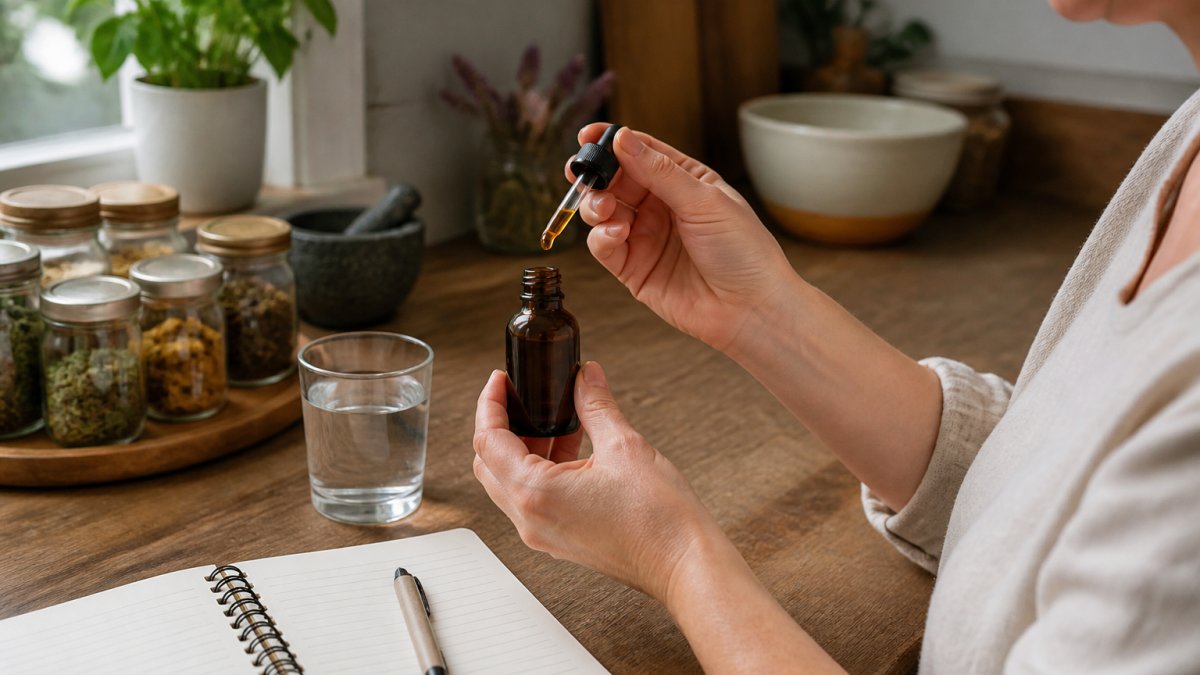
The 20-40 Drop Range and Why It Is Not One-Size-Fits-All
You will see a common example dose of 20 to 40 drops, taken three times daily, for many herbs. The American College of Healthcare Sciences guide to making herbal tinctures presents that range as a general example, not a universal rule. The same source advises checking with an herbalist before relying on it.
Timing, Food, and Duration of Use
Duration is the other half of the question. Many herbalists suggest using a tincture for a set period, then pausing to reassess. A common approach is several weeks on, then a break. If you plan to use a tincture daily long term, read more about daily tincture use from a nurse's perspective before you settle into a routine.
Here is the dosing and timing guidance the article lays out.
| Item | Value | Note |
|---|---|---|
| Common example dose | 20 to 40 drops | Taken three times daily for many herbs |
| Status of that range | General example | Not a universal rule |
| Before relying on it | Check with an herbalist | Advised by the cited source |
| Duration approach | Several weeks on, then a break | Pause to reassess |
| Long-term daily use | Read daily tincture guidance first | Nurse's perspective |
How to Read Herbal Supplement Labels Before You Buy
A label can identify the plant, plant part, extraction method, strength, and whether independent verification is stated.
Start With Identity: Plant, Part, and Species
A label that lists only a common name and no plant part is a label you cannot evaluate. Skip it.
Extraction Ratio and Menstruum: The Numbers Behind the Drops
Our Three Mushroom Blend double extraction tincture is prepared using hot water and alcohol.

Standardized Extracts vs. Whole-Herb Tinctures
A standardized extract is formulated so that a named marker compound falls within a stated range, for example, "standardized to 0.3% hypericin" or "contains 3% rosavins." Standardization improves consistency from bottle to bottle, which matters when comparing one trial period to the next. But the marker compound is not always the one responsible for the effect, and a product can hit the marker while losing other constituents that whole-herb tinctures preserve. Neither approach is automatically safer: standardized extracts are easier to dose consistently, whole-herb tinctures are closer to traditional preparations. Know which one you are buying.
Third-Party Testing and What It Actually Covers
"Third-party tested" is a claim, not a guarantee, unless the label tells you what was tested. Independent testing commonly covers four things:
- Identity, that the plant in the bottle is the plant on the label (often by DNA barcoding or chemical fingerprinting)
- Potency, that marker compounds fall within the stated range
- Contaminants, heavy metals such as lead and arsenic, pesticide residues, and microbial load
- Solvents, residual extraction solvents, where relevant
Look for a certificate of analysis (COA) you can request, a batch or lot number on the bottle, and a testing lab named on the label or website. A COA listing only "pass" with no method and no numbers is marketing, not verification. (Source: National Institutes of Health (NIH) Office of Dietary Supplements)
The Label Checklist
Watch out: a label with no plant part, no extraction ratio, and no lot number tells you almost nothing. Skip it.
Wildwood Usnea Double Extraction Spray →
Herbal Supplements and Medication Interactions You Cannot Ignore
Herbal supplements and medications may raise safety questions for people taking prescriptions. Consult a qualified healthcare professional before using an herbal product with medication.
The Four Mechanisms Behind Most Herb-Drug Interactions
Nearly every clinically important herb-drug interaction runs through one of four pathways:
- Liver enzyme induction or inhibition. Many drugs are broken down by cytochrome P450 enzymes in the liver. Some herbs speed those enzymes up (induction), lowering drug levels and reducing effect; others slow them down (inhibition), raising drug levels and increasing side effects. St. John's Wort is the best-known inducer and a classic example many pharmacists flag.
- Altered drug transport. Compounds such as those in ginkgo and milk thistle can affect P-glycoprotein, a pump that moves drugs in and out of cells, changing how much drug reaches the bloodstream.
- Additive effects. Two substances with the same effect stack. A sedating herb plus a sedating medication can produce more drowsiness than either alone. A blood-thinning herb plus an anticoagulant can push bleeding risk higher.
- Absorption changes. Fiber-rich or mucilage-containing herbs can bind drugs in the gut and reduce absorption if taken at the same time.
Herb and Drug-Class Combinations That Deserve Caution
If you take blood thinners, diabetes medication, blood pressure drugs, antidepressants, or transplant or HIV medications, tell your prescriber about every tincture you use, before you start, not after. Open communication remains the most effective strategy for preventing medication errors while ensuring that your herbal regimen complements rather than complicates your existing clinical care.
The Alcohol Base Is Its Own Consideration
Glycerin-based alternatives exist, but they extract differently, glycerin is a poorer solvent for resins and many alkaloids, so ask before assuming they behave the same as an alcohol tincture of the same herb.
Practical Habits That Actually Reduce Risk
For a deeper look at which combinations deserve caution, read our guide on herbal remedies and medication safety.
Herbal Tincture Side Effects: What to Watch For
If you use calming tinctures, our guide to using calming tinctures safely at home covers formula choice and interaction checks in more depth.
Who Should Avoid Herbal Tinctures
Some people should skip tinctures or get professional clearance first. This is not a scare tactic. It is basic caution.
Talk to a clinician before starting if you:
- Are pregnant or nursing
- Take prescription medication daily
- Have liver or kidney conditions
- Have an autoimmune condition
- Are preparing for surgery
- Are under 18
Alcohol-based tinctures also deserve a second thought for anyone who avoids alcohol for health, recovery, or religious reasons. Glycerin-based alternatives exist, but they extract differently, so ask before assuming they behave the same.
Choosing an RN-Led Tincture for Your Routine
HighFiveHive Nature's Remedies-Kitchen Herbalism offers RN-led kitchen herbalism and brings 40 years of nursing experience.
HighFiveHive Nature's Remedies-Kitchen Herbalism brings 40 years of nursing experience to kitchen herbalism. Get started with HighFiveHive Nature's Remedies-Kitchen Herbalism.
Frequently Asked Questions
How do you take an herbal tincture safely?
Read the product label and consult a qualified healthcare professional before using an herbal tincture.
Can herbal tinctures interact with prescription medications?
If you take medication, consult a qualified healthcare professional before using an herbal product.
What should you do if you have a reaction to a herbal tincture?
If you experience a reaction, contact a qualified healthcare professional.
How long does it take for an herbal tincture to work?
The supplied information does not establish a timeline for noticing an effect. Consult a qualified healthcare professional before using an herbal product.


Leave a comment