
How to Start Clinical Herbalism for Beginners
Table of Contents
- What Clinical Herbalism Is (and What It Isn't)
- Step 1: Build Your Foundation in Herbal Studies
- Clinical Herbalism Certification Requirements You Need to Know
- How to Verify Herbalist Credentials Before You Enroll
- Legal Considerations for Herbal Practitioners
- Building Your Starter Apothecary and Practice Toolkit
- Financial Planning and Avoiding Burnout in Clinical Herbalism
- Frequently Asked Questions
Last Updated: September 20, 2026
What Clinical Herbalism Is (and What It Isn't)
Clinical herbalism is the professional practice of using plant-based preparations to support health while working within clear safety limits. It pairs traditional knowledge with modern safety checks.
What it is not:
- Not a license to treat, cure, or diagnose disease
- Not the same as casual kitchen herbalism
- Not a regulated profession in most states
Step 1: Build Your Foundation in Herbal Studies
Start with the basics before you spend money on any program. A strong foundation covers how plants work in the body and how to prepare them safely.
Core Subjects Every Beginner Should Learn
- Materia medica: the study of individual herbs and their actions
- Plant constituents and basic phytochemistry
- Therapeutic actions and how they apply in practice
- Tinctures, infusions, and decoctions: preparation methods
- Dosage protocols for different body systems
- Contraindications and drug-herb interactions
- Plant identification and ethical wildcrafting
Many beginners skip pharmacognosy and plant identification. That is a mistake. You cannot dose what you cannot identify.
Self-Study vs. Formal Programs
Self-paced learning works for building vocabulary and basic preparation skills. Formal programs add mentorship, clinical hours, and standardized education.
Clinical Herbalism Certification Requirements You Need to Know
Certification requirements vary widely, and no single national license exists for herbalists. Most programs ask for coursework in materia medica, safety, and clinical practice, plus a set number of clinical hours.
Typical requirements across programs include:
- Completed coursework in botanical medicine and safety
- Documented clinical hours under a supervisor
- A final exam or case study portfolio
- Continuing education to keep credentials current
How to Verify Herbalist Credentials Before You Enroll
Verifying herbalist credentials means checking the school, the instructor, and the claims, not just the website. Ask for proof before you pay tuition. The problem is that most beginners collect answers without knowing what a good answer looks like. Here is what to actually listen for.
What to Ask, and What a Real Answer Sounds Like
- Total clinical hours: Ask for the number of supervised, in-person or live-video client encounters, not "case study hours" completed alone at home.
- Who supervises clinical practice: Ask for the supervisor's name, license or credential, and years seeing clients. "Our instructors are experienced herbalists" is not an answer. A named supervisor with a documented practice history is.
- The instructor's own training: Ask which program they graduated from, how long they have practiced, and whether they still see clients. Practitioners who stopped seeing clients years ago may teach theory well but cannot model current clinical judgment.
- Guild membership and standards: The American Herbalists Guild publishes educational and professional standards you can compare a program against. Membership is not a guarantee of quality, but a school that cannot explain why it is or is not a member is a warning sign.
- Alumni you can contact directly: Ask for two or three graduates who are willing to talk. If the school will only provide testimonials it wrote itself, treat that as a red flag.
- Refund policy in full: Read the actual policy document, not the marketing page. Note the deadline, the percentage refunded, and whether materials or registration fees are excluded.
Red Flags That Should End the Conversation
- The program promises "certified clinical herbalist" status in under 100 hours.
- The syllabus lists no supervised client contact, only reading and quizzes.
- The school cannot name a single clinical supervisor.
- Tuition is due in full before you receive a syllabus.
- The refund policy is described verbally but not provided in writing.
A Note on the Word "Certification"
No single national license exists for herbalists, so "certification" means whatever the issuing school decides it means. Two programs can both advertise a "certified clinical herbalist" credential while requiring wildly different hours, supervision, and assessment. That is why the verification step matters more than the credential itself. Compare programs on hours, supervision, and assessment method, not on the word printed on the certificate.
Legal Considerations for Herbal Practitioners
Legal considerations for herbal practitioners come down to scope of practice. In most states, you cannot diagnose, treat, or prescribe for a medical condition unless you hold a clinical license.
What you generally can do:
- Offer general wellness education
- Discuss traditional uses of herbs
- Recommend food-based and lifestyle support
What you generally should not do:
- Tell a client to stop a prescribed medication
- Diagnose a condition or interpret lab results
- Claim an herb will cure a disease
Carry professional liability insurance from day one, even for unpaid practice clients. It costs far less than one legal dispute and signals that you take the work seriously.
Building Your Starter Apothecary and Practice Toolkit
A starter apothecary does not need to be expensive. Begin with a small set of well-studied herbs and a few quality tools, then expand as your practice grows.
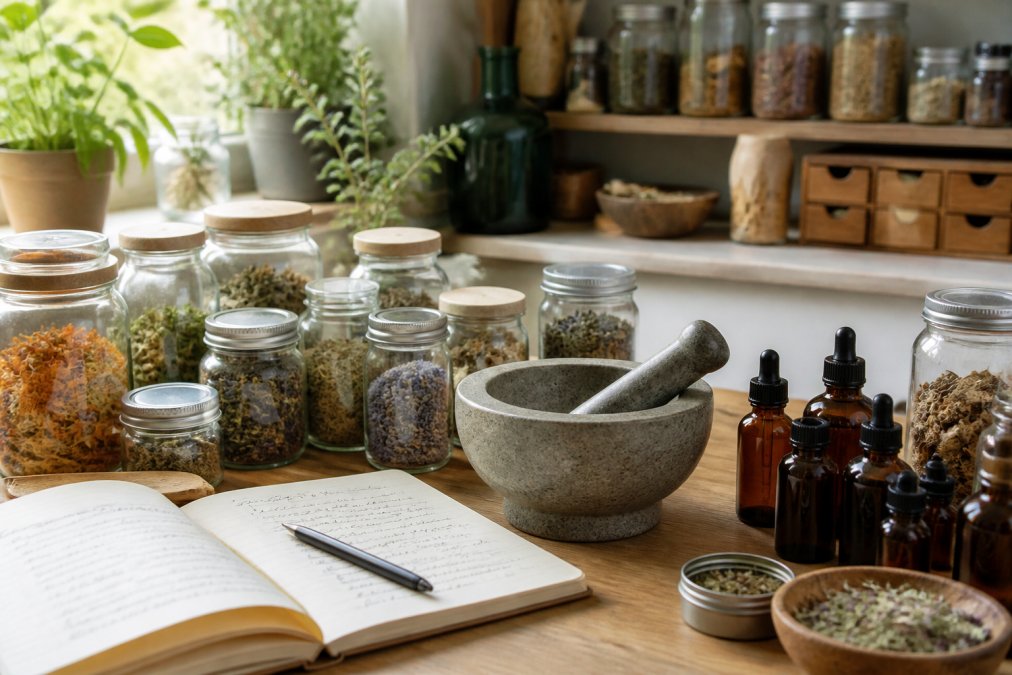
Your core supplies:
- Glass jars for drying and storage
- A mortar and pestle
- Amber dropper bottles for tinctures
- A digital scale for accurate dosing
- Labels with date, herb, and menstruum noted
- A bound notebook for case notes
Financial Planning and Avoiding Burnout in Clinical Herbalism
Financial planning and burnout prevention matter more than most new practitioners expect. Training costs money, and early client income is often slow. Most how-to guides stop at "budget carefully and take breaks." That advice is true and useless. Here is the part competitors skip: how clinical herbalists actually earn money, and how to structure a practice so it does not consume you.
Revenue Models New Practitioners Actually Use
Clinical herbalism is rarely a single income stream. A common pattern is to stack two or three of these:
- One-on-one consultations: The core clinical work. Typically billed per session or per package of follow-ups. Income scales with caseload, which is capped by your available hours and emotional bandwidth.
- Herbal product sales: Tinctures, teas, salves, and custom blends sold alongside consultations. This is where many small practices find margin, but it adds inventory, labeling, and regulatory obligations.
- Classes and workshops: Teaching introductory herbalism, medicine-making, or garden skills. Often the most reliable early income because it does not depend on individual client outcomes.
- Writing and content: Articles, newsletters, and course materials. Slow to build, but it compounds and can feed the other streams.
- Affiliate or retail partnerships: Recommending products you trust. Only worth doing if the products meet your own safety standards.
What to Budget For
Plan for these costs before you take your first client:
- Program tuition and materials
- Clinical supervision fees
- Professional liability insurance
- Business registration and any state or local licensing
- Supplies, jars, bottles, labels, and restocking
- Continuing education each year
- Accounting or bookkeeping help, even part-time
Setting Rates Without Underselling Yourself
New practitioners often underprice because they feel unqualified. That creates two problems: you cannot sustain the practice, and clients may read low prices as low competence. A practical approach is to calculate your annual target income, divide by the number of client hours you can realistically work per week, and add a margin for taxes, overhead, and slow months. Then compare that number to what local practitioners charge.
Burnout: The Part Nobody Warns You About
Clinical work means holding space for other people's health fears, chronic pain, and disappointment when a protocol does not work. That accumulates. The risk is real, and it shows up as compassion fatigue, resentment toward clients, and eventually leaving the field.
Concrete protections that experienced practitioners use:
- Cap your weekly client hours. Decide the number before you start booking, and treat it as fixed.
- Build a referral list. Know who you send clients to when a case is outside your scope. Referring out is not failure; it is scope discipline.
- Schedule admin and rest days. Client days and paperwork days should not be the same days if you can avoid it.
- Keep case notes current. Backlogged notes create a second job you never scheduled.
- Have a peer or mentor to debrief with. Isolation amplifies burnout. A monthly check-in with another practitioner is one of the cheapest forms of prevention.
- Separate your identity from client outcomes. You can do excellent work and still have a client who does not improve. That is the nature of the field.
Treat your practice like a business and a care role at the same time. Stack two or three income streams, budget for recurring costs, cap your client load, and refer out anything outside your scope. That combination keeps you practicing for years instead of months.
Frequently Asked Questions
What does it take to become a clinical herbalist?
Becoming a clinical herbalist typically involves completing a formal education program in herbal medicine, which may include courses in materia medica, phytochemistry, and clinical practice. Most programs require 1,000 to 2,000 hours of study, including supervised clinical hours. You'll also need to understand legal considerations for herbal practitioners, which vary by state. Building a starter apothecary with tinctures and infusions is part of the hands-on training. Always verify program credentials before enrolling.
Do you need a license to practice herbalism?
No federal license exists for herbalists in the United States. However, some states regulate the practice of herbal medicine through licensing or registration, particularly for those who diagnose or treat conditions. Legal considerations for herbal practitioners include scope of practice, business licensing, and liability insurance. Beginners should research their state's requirements and consider working under a qualified practitioner before practicing independently. Always verify herbalist credentials of any program or mentor.
What is the difference between kitchen herbalism and clinical herbalism?
Kitchen herbalism focuses on using everyday herbs for general wellness, often through teas, infusions, and simple tinctures. Clinical herbalism is a professional practice that involves assessing individual health conditions, creating personalized formulations, and monitoring outcomes. Clinical herbalists often have formal training in plant constituents, drug-herb interactions, and dosage protocols. While kitchen herbalism is a great starting point, clinical herbalism requires deeper study and adherence to clinical herbalism certification requirements.
How long does it take to start practicing clinical herbalism?
Most beginners need one to three years of study before practicing clinically. This includes coursework in botanical medicine, anatomy, and pathophysiology, plus supervised clinical hours. Some self-paced programs allow flexible timelines, but you should aim for at least 500 hours of clinical training. Financial planning for a career in herbalism is important, as income may build gradually. Start by verifying herbalist credentials of any program and checking state legal requirements.


Leave a comment