
7 Steps to Safely Identify and Source Culinary Herbs
Last Updated: November 16, 2026
Quick Summary
Safely identify culinary herbs by checking the whole plant, leaf shape, color and texture, then crushing a leaf to confirm its aroma against a trusted field guide and a second source. Source them by vetting suppliers for identity, farm source, growing practices, harvest date and traceability, and never harvest wild plants you cannot confirm with certainty.
- A 2026 HortTechnology study found 78% of consumers perceived cut fresh herbs as safe, while 8% saw them as unsafe.
- Soft herbs like parsley, cilantro, basil, dill and mint wilt fast, so handle them gently and use them soon.
- Poison hemlock has smooth, purple-blotched stems and a musty smell, unlike hairy, carrot-scented wild carrot.
- A plant-identification app or single photo match is not a second opinion before harvesting.
- The FDA warns that once fresh culinary herbs are contaminated, removing or killing pathogens can be difficult.
Table of Contents
- Why Herb Identification and Sourcing Matter for Home Cooks
- How to Identify Herbs: A Step-by-Step Protocol
- The 10 Most Common Culinary Herbs and Their Lookalikes
- Soft Herbs vs Hard Herbs: Why the Difference Changes How You Handle Them
- Wild Herbs for Cooking: Foraging Rules and Toxic Lookalikes
- Sourcing Culinary Herbs Safely from Markets, Farms, and Online Sellers
- Washing, Storing, and Handling Fresh Herbs Without Cross-Contamination
- Build Your Herb Plan with RN-Led Guidance
- Frequently Asked Questions
Why Herb Identification and Sourcing Matter for Home Cooks
Most people assume fresh herbs are safe because they look familiar. According to a 2026 HortTechnology study on consumer perceptions of fresh culinary herbs, 78% of surveyed consumers perceived cut fresh herbs as safe, while 8% saw them as unsafe.
Learning how to safely identify and source culinary herbs is a kitchen skill, not a hobby. It protects your food, your health, and your money.
How to Identify Herbs: A Step-by-Step Protocol
Identifying herbs starts with a repeatable process, not a guess. Use these steps every time, whether you're in a garden, a farmers market, or your own fridge.
- Look at the whole plant. Note whether the stem is soft or woody.
- Check leaf shape. Compare the outline, edges, and how leaves attach to the stem.
- Study leaf color and texture. Look for smooth, fuzzy, waxy, or matte surfaces.
- Crush one leaf and smell it. Aroma confirms more than appearance alone.
- Compare against a field guide or trusted reference. Never rely on memory.
- Confirm with a second source before you harvest or cook with it.
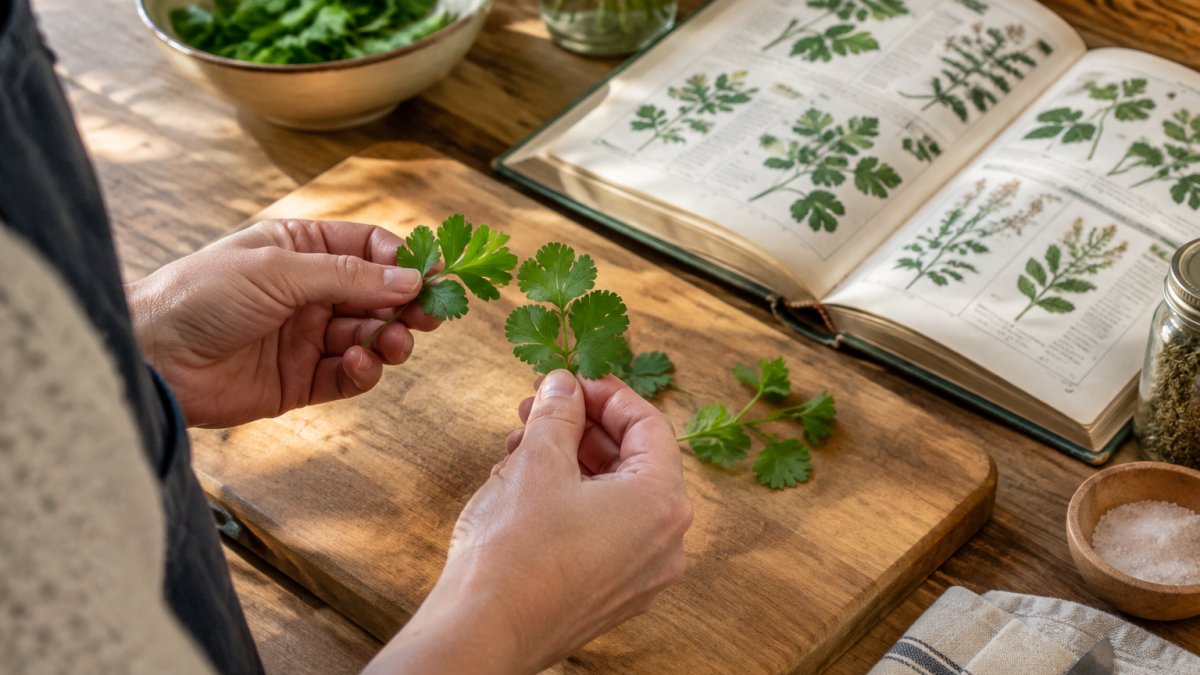
Check Leaf Shape, Color, and Texture
Leaf shape is your first filter. Parsley has curled or flat divided leaves, while cilantro's leaves are more feathered and lobed. Color ranges from deep green to pale green depending on the herb and freshness. Texture matters too: fuzzy leaves like sage feel different from the smooth, glossy leaves of basil.
Crush a Leaf and Read the Aroma
Aroma is the step most people skip, and it's the one that saves you. Crush a small leaf between your fingers and smell it right away. Cilantro often smells citrusy and sharp, while parsley smells grassy and mild. If the scent doesn't match what you expect, stop.
The 10 Most Common Culinary Herbs and Their Lookalikes
Here are the ten culinary herbs you'll meet most often, plus the lookalike that causes the most confusion for each one.
| Herb | Key Feature | Common Lookalike | How to Tell Them Apart |
|---|---|---|---|
| Parsley | Divided, curly or flat leaves | Cilantro | Parsley smells grassy; cilantro smells citrusy |
| Cilantro | Feathered, lobed leaves | Parsley | Cilantro bolts fast and has a sharp scent |
| Basil | Smooth, rounded leaves | Mint | Basil smells sweet and peppery; mint smells cool |
| Mint | Serrated, fuzzy-edged leaves | Lemon balm | Mint has a cool menthol scent |
| Oregano | Small, oval, slightly fuzzy leaves | Marjoram | Oregano is sharper; marjoram is sweeter |
| Thyme | Tiny leaves on thin woody stems | Savory | Thyme smells earthy; savory is peppery |
| Rosemary | Needle-like leaves on woody stems | Lavender | Rosemary smells piney; lavender is floral |
| Sage | Soft, gray-green, fuzzy leaves | Artemisia varieties | Sage smells savory; artemisia is bitter |
| Dill | Fine, thread-like leaves | Fennel | Dill is sharper; fennel smells like licorice |
| Tarragon | Long, narrow, smooth leaves | French tarragon vs. Russian | French tarragon has real anise flavor |
If you've just identified these herbs and want to put them to work, our guide to kitchen herbs for digestion covers nine options and how to use them.
Soft Herbs vs Hard Herbs: Why the Difference Changes How You Handle Them
Soft herbs have tender, flexible stems. Think parsley, cilantro, basil, dill, and mint. Hard herbs have woody stems and tougher leaves, like rosemary, thyme, sage, and oregano.
The difference decides how you store and cook them. Soft herbs wilt fast and bruise easily, so handle them gently and use them soon. Hard herbs hold up longer and stand up to heat, which is why they go in at the start of cooking while soft herbs go in at the end.
Wild Herbs for Cooking: Foraging Rules and Toxic Lookalikes
Foraging carries real risk, and the honest advice is simple: if you are not certain, do not harvest. The Chestnut School of Herbal Medicine's foraging guidance advises proper identification before harvesting and says plainly not to harvest when in doubt.
The table below pairs common wild culinary herbs with the lookalike that causes the most trouble. The same careful habit of checking identification and safety applies when considering herbs for relaxation, since familiar uses do not make a plant safe for everyone.
| Wild culinary herb | Toxic or inedible lookalike | What separates them |
|---|---|---|
| Wild carrot (Queen Anne's lace) | Poison hemlock | Poison hemlock has smooth, purple-blotched stems and a musty, unpleasant smell; wild carrot stems are hairy and the scent is carrot-like |
| Wild garlic (ramps, field garlic) | Death camas | Wild garlic smells strongly of onion or garlic; death camas has no onion odor and its flowers are cream-colored rather than white |
| Wild fennel | Poison hemlock | Fennel has a strong licorice scent and finely divided thread-like leaves; poison hemlock lacks the licorice smell |
| Wild mint | Other mint-family plants, including some with unpleasant or medicinal flavors | Mint has a square stem and a cool menthol scent; confirm the scent rather than relying on leaf shape alone |
| Wild sorrel | Plants with similar arrow-shaped leaves | Sorrel has a tart, lemony taste from oxalic acid; taste a tiny amount only after every other check passes |
| Wild thyme | Other low-growing woody herbs | Thyme has tiny opposite leaves on wiry stems and an earthy, pungent scent; crush a leaf and compare |
A few of these pairings are genuinely dangerous. Poison hemlock and death camas are both toxic enough that a single misidentification can send someone to the hospital. That is why the protocol below matters more than any single identification tip.
A Foraging Protocol for Uncertain Plants
- Confirm the habitat and season. A plant growing in the wrong place or at the wrong time of year is a warning sign. Wild garlic, for example, emerges in early spring; a similar-looking plant in late summer deserves extra scrutiny.
- Check the stem. Note whether it is soft or woody, hairy or smooth, round or square, and whether it has blotches or a milky sap.
- Examine the leaf arrangement. Are leaves opposite or alternate? Are they simple or divided? How do they attach to the stem?
- Crush a leaf and smell it. Aroma is often the fastest tiebreaker, but it is never the only check.
- Compare against a regional field guide. A guide written for your area will include the local lookalikes a generic guide leaves out.
- Get a second opinion. Show a photo and, if possible, a sample to an experienced forager or a local extension office before you harvest.
- Harvest a small amount first. Even after confirmation, take only what you will use and test a small quantity before cooking a full dish. (Source: U.S. Food and Drug Administration guidelines)
Watch out: a plant-identification app or a single photo match is not a second opinion. Apps are useful for generating candidates, but they can be wrong, especially with young plants, damaged leaves, or closely related species.
- Learn from an experienced forager before going alone
- Use a regional field guide, not a generic one
- Never harvest from roadsides or sprayed areas
Foragers worried about lookalikes should understand why professional herbal safety guidance matters. Our article on why professional herbal safety matters explains the reasoning behind that caution.
Sourcing Culinary Herbs Safely from Markets, Farms, and Online Sellers
Sourcing is where food safety and quality meet. Traceability and food-safety information support tracing a product backward and forward through the supply chain, especially when something goes wrong. In plain terms: you want to know where your herbs came from, who grew them, and when they were harvested.
Most shoppers evaluate herbs on appearance alone. A better approach is a short, repeatable supplier check covering identity, growing practices, freshness, and traceability, at a farmers market, grocery store, or online.
A Supplier-Vetting Checklist
- Identity. Can the seller name the specific herb and, where relevant, the variety? Flat-leaf parsley and curly parsley are different products; French tarragon and Russian tarragon behave differently in the kitchen. A seller who cannot name the variety may not know the product well.
- Source. Can the seller name the farm, region, or grower? A farm name and location are the minimum. "Imported" or "local" alone is not traceability.
- Growing practices. Ask whether the herbs were grown conventionally or organically, and whether pesticides were used. For herbs you plan to eat fresh and uncooked, this matters more than for herbs that will be cooked.
- Harvest or pack date. Fresh herbs degrade quickly. A visible harvest or pack date lets you judge freshness; a label with only a sell-by date tells you less.
- Handling and storage. At a market, check whether herbs are kept cool, shaded, and covered. Wilting, yellowing, or slimy stems are signs of poor handling or age.
- Traceability. Can the seller trace a specific bunch back to a specific farm and harvest? This is what makes a recall or a contamination report actionable.
At a farmers market, ask these questions directly. In a grocery store, the produce manager or the label is your source. Online, the product page and the seller's response to a direct question are your evidence.
Evaluating Online Sellers
- Publishes the farm or grower behind each product
- Lists harvest or pack dates and storage instructions
- Provides a lot or batch number on the package
Watch out: buying loose, unlabeled herbs from an online seller with no sourcing information gives you no way to trace a problem or confirm the herb is what the listing says.
Freshness and Contamination Checks at the Point of Sale
- Look for freshness signals. Crisp leaves, intact stems, and a clean, bright color are good signs. Wilting, browning, yellowing, or slimy patches are not.
- Smell the bundle. Fresh herbs should smell like themselves. A musty or fermented odor suggests age or poor storage.
- Check for contamination. Look for visible soil, grit, insects, or mold. Soil on fresh herbs is a reminder that they need thorough washing before use.
For a deeper set of criteria when vetting sellers, see our guide to evaluating quality standards for herbal remedy sourcing.
Washing, Storing, and Handling Fresh Herbs Without Cross-Contamination
Fresh herbs need washing, and they need it done right. The FDA's guidance on fresh culinary herbs warns that once herbs are contaminated, completely removing or killing pathogens can be difficult. Prevention beats cleaning.
- Wash hands before and after handling herbs
- Rinse herbs under cool running water
- Dry thoroughly with a clean towel or spinner
If you're combining several herbs in one dish or remedy, our guide on how to safely combine herbs walks through the handling details.
Build Your Herb Plan with RN-Led Guidance
Identifying and sourcing culinary herbs safely takes practice, and it helps to have someone who knows the safety side. HighFiveHive Nature's Remedies-Kitchen Herbalism is built on 40 years of nursing experience and a kitchen herbalism approach.
Frequently Asked Questions
How can I tell culinary herbs apart from poisonous plants?
Never eat a plant you cannot identify with certainty. Poisonous lookalikes exist for several common herbs, so check leaf shape, stem structure, and aroma against a reliable field guide, and confirm with a second source such as a local extension office or an experienced forager. The FDA warns that once fresh culinary herbs are contaminated, removing pathogens is difficult, and misidentification carries its own risk. If you are in doubt at any point, do not harvest. Buy culinary herbs from a verified seller instead.
Are wild herbs safe to eat?
Wild herbs are only as safe as your identification and the ground they grow on. Foraging guidance advises proper identification before harvesting and says not to harvest when in doubt. Avoid roadsides, sprayed lawns, and industrial lots because contamination is invisible. Perception is not proof for a specific plant or batch. Treat wild herbs for cooking as a skill to build slowly, and start with two or three unmistakable species.
What should I check when buying fresh culinary herbs?
Look for firm stems, bright color, and no wilting, yellowing, or sliminess. Smell the bundle: fresh herbs should carry a clear aroma, not a sour or musty one. At farmers markets, ask how the herbs were grown and whether they were washed. Traceability and food-safety reporting support backward and forward tracing when problems occur, so sellers who can answer sourcing questions are a better bet. Skip bundles stored in standing water or direct sun.
How should I wash and store fresh culinary herbs?
Rinse herbs under cool running water and dry them in a salad spinner or between clean towels before storing. Wash your hands first, and keep raw herbs away from cooked food and ready-to-eat items to limit cross-contamination. Label bundles with the date so you use older herbs first, and discard anything slimy or off-smelling.


Leave a comment