
Herbalista Alternatives: RN-Led Herbalism Support
Table of Contents
- Why Seek an Herbalista Alternative for Nursing Support?
- RN-Led Herbalism Benefits Over Generalist Herbalists
- Herbal Support vs. Pharmaceutical Standard of Care
- How to Verify Herbalist Credentials Before You Book
- Integrative Health Consultation Expectations: What Happens?
- Liability, Insurance, and Scope of Practice for Nurse-Herbalists
- Practical Workflow Integration: Bringing Plant Medicine Into Daily Care
- Conclusion: Choosing the Right RN-Led Herbalism Path
- Frequently Asked Questions
Last Updated: September 5, 2026
Why Seek an Herbalista Alternative for Nursing Support?
The herbalista alternative for nursing support centers on a crucial distinction: who is interpreting the botanical information you find online. Many have tried DIY herbal remedies, only to wonder if they are preparing them correctly or if the herbs are safe given their medications and health conditions.
Registered Nurse-led herbalism bridges traditional plant knowledge and clinical safety, not replacing your physician, but adding professional scrutiny to natural wellness.
When managing a complex condition like diabetes or navigating drug interactions, you need guidance that respects both herbal tradition and pharmacology. A nurse-led model offers that blend, prioritizing patient safety.
RN-Led Herbalism Benefits Over Generalist Herbalists
RN-led herbalism benefits become apparent when you discuss your health history. A Registered Nurse brings clinical experience in assessing symptoms, understanding medication interactions, and recognizing red flags a non-clinical herbalist might overlook.
A nurse asks questions beyond the standard intake form, connecting sleep patterns, stress levels, and lab results to your wellness goals.
This foundation also means better communication with your primary care provider. A nurse-herbalist speaks the language of conventional medicine, easing coordination with your existing care plan.
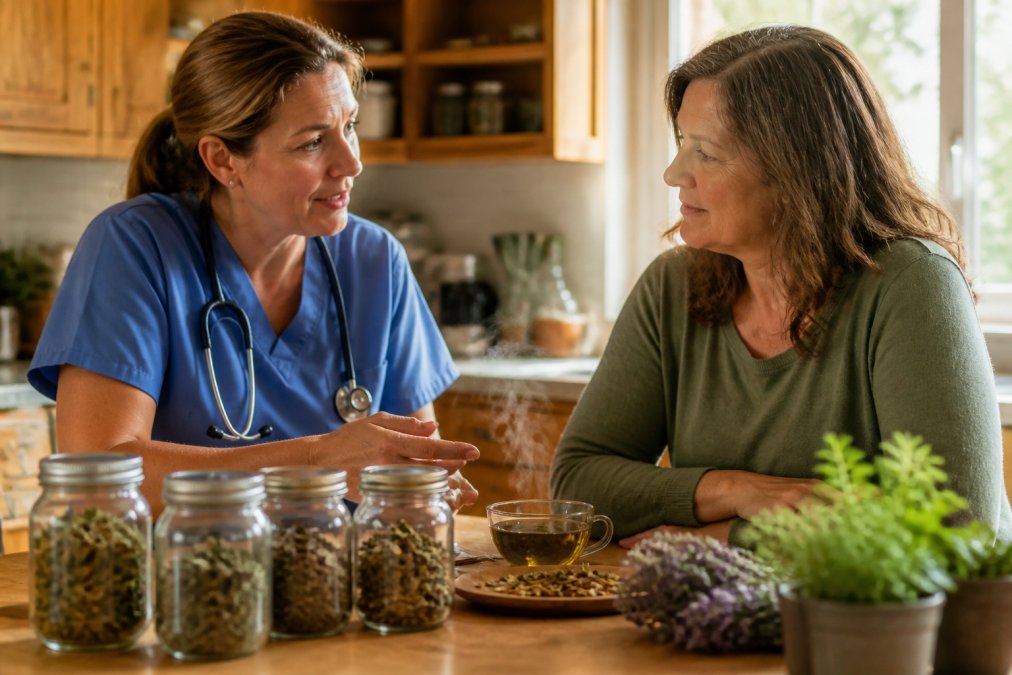
Herbal Support vs. Pharmaceutical Standard of Care
A meaningful comparison between herbal support and the pharmaceutical standard of care must move beyond platitudes and confront actual pharmacology.
Consider the mechanism of action. A pharmaceutical like metformin for type 2 diabetes works through well-defined pathways: it decreases hepatic glucose production, increases insulin sensitivity, and reduces intestinal glucose absorption. Its efficacy is measured in randomized controlled trials with HbA1c reductions of 1-1.5% on average (peer-reviewed research). An herbal alternative like berberine, which has been studied in meta-analyses of randomized trials, appears to activate AMP-activated protein kinase (AMPK), a master regulator of cellular energy homeostasis. Some studies report HbA1c reductions comparable to metformin, but the evidence base is smaller, the preparations are not standardized by the FDA, and the long-term safety data is thinner. This is not a reason to dismiss berberine; it is a reason to understand what you are actually recommending.
Pharmaceuticals are single molecules with known dose-response curves. Herbs are complex mixtures of hundreds of compounds. St. John's Wort induces cytochrome P450 enzymes, particularly CYP3A4, reducing plasma concentrations of drugs like warfarin, cyclosporine, and oral contraceptives by 30-50% or more, a patient on warfarin could see INR drop into a subtherapeutic range, increasing stroke risk (the FDA). Conversely, grapefruit juice inhibits CYP3A4, potentially raising levels of certain statins and calcium channel blockers to toxic ranges.
Pharmaceuticals undergo FDA approval based on rigorous efficacy and safety data. Herbal supplements are regulated under DSHEA, presumed safe until proven otherwise with no pre-market approval, placing greater burden on the practitioner to evaluate quality, sourcing, and adulteration (the FDA).
Herbs are not 'gentle' or 'safe' by default; they are biologically active. The nurse evaluates the whole medication list, checks for interactions using resources like the Natural Medicines Comprehensive Database, and communicates with the prescribing physician.
A practical framework for comparison in clinical practice:
| Clinical Question | Pharmaceutical Standard of Care | RN-Led Herbal Support |
|---|---|---|
| What is the evidence base? | Large RCTs, meta-analyses, FDA-approved indications | Smaller RCTs, traditional use, emerging research; quality varies |
| How is dosing determined? | Standardized by weight, age, renal/hepatic function | Individualized based on constitution, but often lacks standardized potency |
| What is the onset of action? | Often rapid, hours to days | Often slower, weeks to months for chronic conditions |
| What is the interaction risk? | Documented, predictable, requires monitoring | Variable; many herbs affect CYP450 enzymes; requires active screening |
| Who is responsible for oversight? | Prescribing physician with legal liability | Nurse-herbalist with professional liability insurance and scope-of-practice limits |
| What is the regulatory status? | FDA-approved, prescription required | DSHEA-regulated, over-the-counter, no pre-market approval |
This comparison equips the nurse with analytical tools for defensible recommendations. If a patient asks about milk thistle alongside a statin, the answer requires checking whether silymarin affects CYP450 enzymes, it does, primarily CYP3A4 and CYP2C9, and whether that matters for the specific statin. Simvastatin and lovastatin are metabolized by CYP3A4; pravastatin is not.
The goal is a framework where the nurse articulates risks, benefits, and unknowns, then collaborates with the patient and physician to choose the safest path.
How to Verify Herbalist Credentials Before You Book
Before committing to any practitioner, verify herbalist credentials by asking direct questions about educational background and clinical experience.
Look for specific qualifications such as a Registered Nurse license, verifiable through your state's board of nursing, and certifications from recognized herbalism programs, such as a Certified Clinical Herbalist designation.
- Ask for their nursing license number and verify it with your state board
- Inquire about their specific training hours in clinical herbalism
- Ask how they handle clients who are taking prescription medications
- Request information on their experience with your specific health concern
- Confirm whether they carry professional liability insurance
Professional liability insurance protects you if the practitioner provides negligent advice. A legitimate professional will expect these questions and have straightforward answers.
Integrative Health Consultation Expectations: What Happens?
Your integrative health consultation should include a thorough review of health history, current medications, and wellness goals. Unlike a quick online quiz, it involves a detailed conversation about lifestyle, diet, stress levels, and chronic conditions.
The consultation begins with a comprehensive intake covering primary concerns, blood sugar management, hormonal balance during perimenopause, or joint discomfort. The practitioner asks clarifying questions, then explains how botanicals might support your goals, after understanding your current management plan.
You should leave with a clear, personalized plan including specific teas or tinctures, dosage guidance, lifestyle modifications, and realistic expectations over a timeframe.
Liability, Insurance, and Scope of Practice for Nurse-Herbalists
Understanding liability, insurance, and scope of practice is crucial for both practitioners and clients. A Registered Nurse is bound by a state-defined nursing scope; practicing herbalism means navigating the legal landscape separating nursing advice from complementary and alternative medicine.
The nurse cannot prescribe herbs like a physician, but can educate clients on botanical options and provide wellness support. This is why professional liability insurance is non-negotiable; a nurse-herbalist should carry a policy covering their holistic practice, not just nursing duties.
For the client, this means recourse and a professional standard. When you choose an herbalista alternative for nursing support, you engage with someone operating under a professional code of conduct with insurance that holds them accountable. Always ask about scope of practice and insurance coverage during your initial consultation.
Practical Workflow Integration: Bringing Plant Medicine Into Daily Care
For a nurse-herbalist, the hardest part of integrating plant medicine is documenting the recommendation in a way that is clinically defensible, legally sound, and useful to the care team.
Documentation in the EMR/EHR System
When you recommend an herbal protocol, it must be documented in the EMR like any other intervention. Most EMR systems, including Epic and Cerner, lack a dedicated field for herbal supplements. The Joint Commission requires all medications, including supplements, be documented in the medication reconciliation list.
A practical workflow for EMR documentation includes:
- Add the herb to the active medication list. Use the generic botanical name (e.g., Vitex agnus-castus for chasteberry) rather than a brand name, and include the dose, frequency, and route. If the EMR uses RxNorm or a similar terminology standard, search for the supplement there.
- Document the indication and the plan. In the assessment or plan section, write a note that includes the patient's symptoms, the herbal recommendation, the expected outcome, and the timeframe for reassessment. For example: 'Patient reports 6 months of perimenopausal hot flashes, 8-10 per day. Discussed chasteberry 400 mg daily for 3 months to support hormonal balance. Will reassess at next visit. Patient educated on potential interactions with hormonal contraceptives.'
- Flag for interaction checking. Most EMRs have drug-drug interaction checking. Herbal supplements are often not in the interaction database, so the nurse-herbalist must manually review the patient's full medication list for known CYP450 interactions or additive effects. This is a clinical judgment task, not an automated one.
- Communicate with the primary care provider. Send a secure message or note to the PCP summarizing the herbal recommendation and the rationale. This is not asking permission; it is ensuring continuity of care and giving the PCP the opportunity to raise concerns.
Building a Reassessment Protocol
Herbal medicine requires a defined reassessment schedule, a 4-6 week trial for acute symptoms or 8-12 weeks for chronic conditions, then evaluate against baseline. Document baseline using a validated tool where possible, such as the Menopause Rating Scale (MRS) or Pittsburgh Sleep Quality Index (PSQI).

Integrating With Daily Patient Routines
For the patient, the workflow is about habit stacking, tying the herbal protocol to existing daily anchors. For example:
- Morning routine: A patient managing blood sugar might take berberine 500 mg with breakfast, alongside their metformin (after checking for additive hypoglycemia risk). The habit anchor is the breakfast plate.
- Evening wind-down: A patient with insomnia might brew a cup of passionflower tea 45 minutes before bed, anchored to the act of brushing teeth.
- Midday stress break: A patient with anxiety might use a lemon balm tincture at 3 p.m., anchored to their afternoon coffee break.
This creates a sustainable behavioral protocol. The nurse-herbalist should provide a written schedule with the herb, dose, time of day, and anchor habit to reduce cognitive load and increase adherence.
Monitoring for Adverse Effects
A professional workflow includes a plan for adverse event monitoring. The patient should know which symptoms warrant stopping the herb and calling the office (e.g., rash, gastrointestinal distress, unusual fatigue) versus expected initial adjustments. Schedule a follow-up within 2 weeks of starting a new protocol.
The Missing Piece: Professional Liability Documentation
Your documentation is your primary defense in a malpractice claim. If a patient experiences an adverse reaction, the record must show that you:
- Conducted a thorough assessment including allergies, current medications, and relevant lab values
- Screened for known interactions using a reputable database
- Provided clear dosing instructions and warnings
- Scheduled appropriate follow-up
- Communicated with the patient's other providers
If any of these steps are missing from the record, your liability insurance may not cover you, and your nursing license may be at risk. This is not theoretical; state boards of nursing have disciplined nurses for practicing outside their scope when they recommended supplements without adequate assessment or documentation.
This workflow, documentation, reassessment, habit integration, adverse event monitoring, and liability-aware record-keeping, separates a professional nurse-herbalist from a wellness influencer.
Conclusion: Choosing the Right RN-Led Herbalism Path
Choosing the right RN-led herbalism path requires looking beyond marketing claims to the provider's qualifications and safety practices. The herbalista alternative is not about finding a magic herb, but a professional who can guide you safely and effectively.
Navigating chronic conditions like diabetes, hormonal changes, or joint pain alongside herbal remedies is complex. HighFiveHive Nature's Remedies-Kitchen Herbalism offers this through an RN-led kitchen herbalism approach, backed by 40 years of nursing experience, providing personalized guidance for immune health, natural diabetes management, and women's wellness.
Get started with HighFiveHive Nature's Remedies-Kitchen Herbalism and experience the confidence of working with a professional who integrates clinical knowledge with the tradition of botanical medicine for your long-term vitality.
Frequently Asked Questions
What is the difference between a community herbalist and a nurse herbalist?
A community herbalist typically trains through apprenticeship or non-accredited programs and focuses on traditional plant knowledge. A nurse herbalist holds an active RN license and clinical experience, which means they understand pharmacology, contraindications, dosing, and how herbs interact with prescription medications. That clinical background translates to more thorough safety protocols, better screening for red flags, and guidance built on both traditional use and evidence-based practice. For anyone managing chronic conditions or taking multiple medications, the nursing perspective adds a layer of protection that generalist training does not provide.
How do I verify the credentials of an herbalist providing health support?
Start by asking for their nursing license number and state board of nursing confirmation. You can also check for certification from a recognized body like the American Herbalists Guild, which requires clinical experience and peer review. Ask how long they practiced as an RN, what clinical settings they worked in, and whether they carry professional liability insurance. A legitimate nurse-herbalist will openly share this information and will stay within their legal scope of practice by offering general wellness education rather than diagnosing or prescribing.
Are there legal regulations for herbalists in the United States?
Herbalists are not federally licensed as a distinct profession in the United States, so regulation varies by state. Most states allow herbalists to sell botanical products and offer educational consultations, but they cannot diagnose, treat, or prescribe without a medical license. Nurses who practice herbalism must also follow their state board of nursing rules, which place limits on what falls within nursing scope of practice. Before working with any herbalist, ask which state regulations apply to their practice and confirm that they operate within those legal boundaries.
What should I look for in a professional herbalism consultation?
A professional consultation should open with a thorough health history, including current medications, diagnosed conditions, and past surgeries. The practitioner should ask about your goals and then explain which botanicals they recommend and why, citing both traditional use and any relevant clinical research. Expect clear dosing instructions, realistic timelines for results, and specific signs that indicate you should stop or check in. You should also receive guidance on potential drug interactions and a clear explanation of what falls outside the herbalist's scope of practice.
This article was written using GrandRanker


Leave a comment